Crafting Fantasy: The Creative Journey Behind The World of Pillar

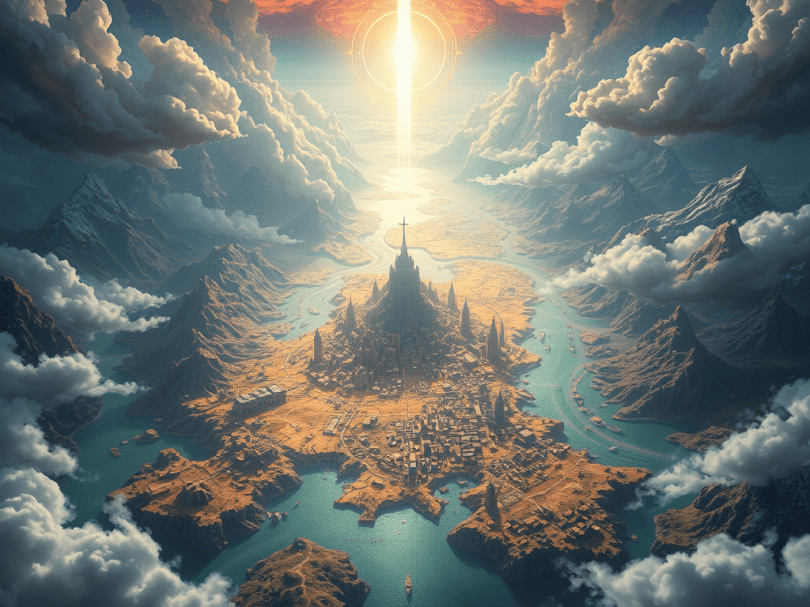
The World of Pillar is the larger moniker I have given to what I assume is going to be a trilogy of books. The first of these has been given the title The Gunslinger and the Beast, with the next in line being titled The Mamon Engine. It might seem odd at first that I know the first two books’ titles, but oddly enough, I am more sure about the second book’s title than I am the first. That is because, currently, the second of the books is nearly done, and the first is about a third of the way done. In the beginning, these first two books were just one volume. However, after hitting just over 110,000 words in the book, I decided it might be better to split the story into two and allow each of the two main narratives to breathe a bit more on their own.

The current plan is to finish this first story and publish it, followed by finishing up the second and publishing it. After those, the third story will combine characters and storylines from the first two as the main story arc concludes. Below, you will find some of the notes on the story and the world I have been playing with. Enjoy this look into the creative process I am working on.

I have envisioned that The World of Pillar is, in fact, Earth far into our future. I have long been a student of the fantasy genre, and many of the classic and modern writings have entertained me for years. When I was in my undergrad, I started reading The Wheel of Time by Robert Jordan and later finished by Brandon Sanderson. It took me years to actually finish the series, not only because it wasn’t finished being written yet, but because it was a very thick tale to move through.

I love Jordan’s fantasy world! While I could never hope to write something on his level, he inspired me greatly. One of the aspects that I really enjoyed was how Randland used to be Earth, but it was in the far future, and the world had been broken to the point that no one remembered it as it had been before. Jordan was sneaky, though, and gave hints throughout the books about the world’s previous status. A lot of the prophecies and histories also provide hints.

When I sat down to write my fantasy, this was a path I wanted my world to trod as well. However, while you really have to look closely at Jordan’s novels, I wanted mine to be fairly obvious if you took the time to really look at the world I was revealing. So, while my text doesn’t come out and say that the world is Earth and nothing overtly yells it out, you can infer the reality of this through many aspects of the story and world. One of the main aspects of this is shown in the map of the surface of Pillar. I created this map and had an artist draw it up from my creations.

Maps and Other Drawings:

The map of Pillar was created using a flood map from the YouTube channel called Worldostats and their video titled USA Flood Map | Sea Level Rise (0-4000 meters). If you watch the video and stop it when the sea level is at 280 meters, you will see the main area of Pillar pop out. I have included a screenshot of the video and placed a grey circle around where Pillar was then pushed up out of the earth, seven miles into the air, after all the flooding.
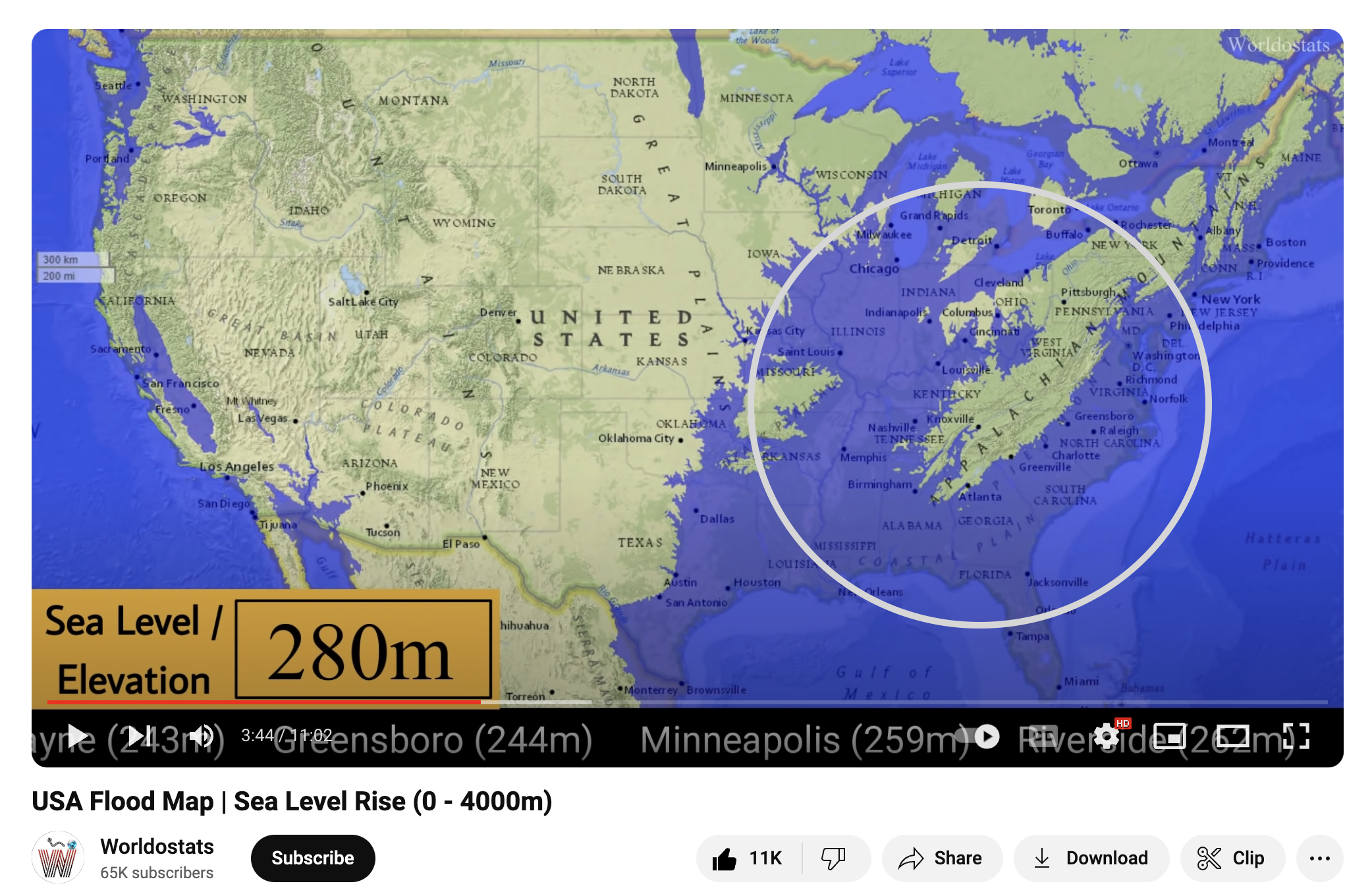
YouTube video from Worldostats, that I paused to create my first map.

I actually laid a piece of tracing paper over my laptop screen to trace the general shape of this map onto paper. Then, once I had the general shape, I bought a full-size map of the eastern coast of the United States and began coloring. In an evening or two, I had a rather large map that I could use to really look into the details of travel and areas that I could play with. It’s interesting to me that with a couple of crayons and a cheap map from Amazon, one can give life to a world that is as vast and intricate as The World of Pillar. Here is that map.
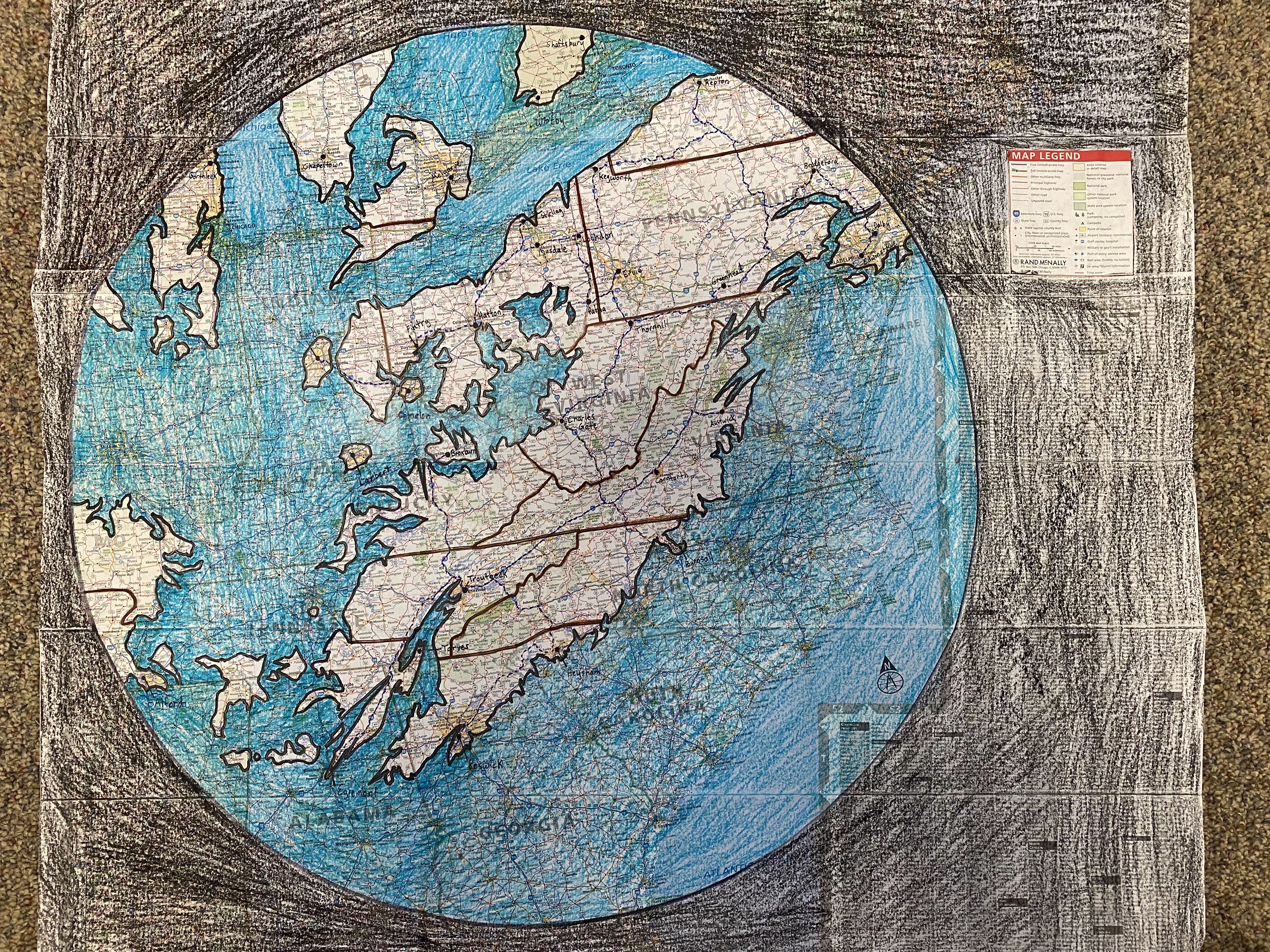
The real world map that I destroyed to create a full-size map of Pillar.

This map hangs above my table downstairs in my basement, where I have written most of the story. Other pictures are hanging in the same place. I photocopied pictures from historical texts from when I was still in college, and other things. There are character sheets and timelines, as well as other drawings of armor, weapons, and even flying ship floor plans.

The folding table in my basement is surrounded by my maps, drawings, and ideas. This is where I do a lot of the writing for my books.

Where did the story come from?

When I was back in college, I had two fantasy stories in my head. One of them was a grand fantasy that would take place on top of a huge pillar up in the sky. I was inspired by the video game Chrono Trigger and the Kingdom of Zeal in the Antiquity timeline. I loved that idea of a place separated from the rest of the world, up in the sky. The other story was a much more personal and down-to-earth fantasy that involved animals in a time far in the future when there were no more humans. This story was going to feature mainly dogs, but also other animals like deer and cats.

In the end, I took both ideas and combined them into a single world and story. The dogs, of course, remain, and the use of other animals as well, but I have chosen to place them into a more grand and far-reaching story in the future, where the creation of a giant plateau in the clouds has nearly destroyed Earth. When the ideas were still new, I first envisioned a female protagonist who was a magic user but never aged beyond twelve. I wanted to play off the idea that wizards were usually frail in physical form but powerful in magic, and using a young girl played into this idea nicely. However, the more I got into the story and started really detailing some of the plot points, the more I got uncomfortable placing a young girl in some of those situations.

I split that character into two separate characters. Thus, the characters of Christoph and Meshiah were born. At the beginning of my writings, Meshiah was a human throughout the story. Still, the more I wrote about her and Schalk (a Brown Dog), the more I really wanted their relationship to be able to blossom into something more than just a friendship. While interspecies relationships are mentioned as being a thing in the world, I didn’t want to directly tackle that sort of ethical difficulty in the main storyline. As such, allowing Meshiah to be changed into a brown dog species in the beginning created a fun narrative beat and also a direct connection to Schalk as a romantic interest in her new life.

Meshiah and Schalk. I commissioned this picture before I switched her to being a Brown Dog.

The Magic of Creativity:

Magic has captivated me for as long as I can remember. As children, we all dream of possessing powers beyond our reach. I recall a neighbor friend standing on a tree stump, arms outstretched, convinced she could feel herself lift off the ground. She’d rise onto her toes, only to “lose it” and fall back down, claiming she just needed more practice before she could truly fly.

I believe this longing for the fantastic is hardwired into us. Yet, as we grow older and reality settles in, many of us lose touch with that wonder. It’s a tragic loss, really. But there are still moments when we allow ourselves to indulge in that innate desire for magic, like when we become emotionally invested in a great movie, a compelling book, or a great video game.

Take Old Yeller, for example. (Fair warning: spoiler ahead, though the Disney film is over 65 years old, and the book is even older.) In the story, a frontier family faces hardship when the father, Jim, leaves to sell cattle, entrusting his son, Travis, with the responsibility of the household. During Jim’s absence, Travis meets an old yellow dog who proves his worth by saving his younger brother from a bear. Though Travis initially dislikes the dog, their bond grows strong, and eventually, he loves the dog.

At the story’s heart-wrenching climax, Old Yeller fights off a rabid wolf. During that time, there was no cure for rabies. When the dog shows signs of the disease, Travis’ mother hands him a rifle, knowing what has to be done. With a heavy heart, Travis shoots his beloved companion, breaking not only his own heart but the hearts of countless readers and viewers.

However, the story doesn’t end on a hopeless note—Old Yeller had fathered a pup before his tragic end. Though Travis initially resists bonding with the puppy, he eventually recognizes Old Yeller’s spirit in the pup and names him “New Yeller.” My retelling may be simple, but even now, the memory brings tears to my eyes. The emotional impact of a boy having to put down his best friend is a wound many of us still carry, who have seen the film or read the book.

Why do stories like this affect us so deeply? Why do we cry over fictional characters and events? After all, we aren’t the ones forced to kill our beloved pets. Yet, we feel it as if we are. The emotion of it is real.

That’s the magic of storytelling. When we watch a film, read a book, or play a game, we become a part of those worlds. We are Travis Coates. We are Master Chief, Frodo Baggins, Chrono, Rand Althor, or Link. For a time, we embody their struggles and triumphs, feeling every loss and every victory. It’s why we choke up when Samwise Gamgee declares he can’t carry the ring, but that he can carry Frodo, lifting him to his shoulder.

In these moments, we’re not just spectators—we are the heroes. I may never save the world from an evil sorcerer in reality, but through stories, I can be Link, fighting to protect Hyrule from Ganon’s grasp. I’m only a school counselor and author in the real world, but through the boundless creativity of humanity, I can rule kingdoms, save worlds, lose them, and live a thousand lives.

This is the true magic we all possess: the ability to connect to infinite worlds through our imaginations. It’s what makes us truly human. Magic is real—alive in every story we tell, in every fantasy we explore, and in the infinite potential we hold within ourselves.

D. Michl Lowe

How Brandon Sanderson Gives Me Hope as an Author

Brandon Sanderson, author of books like The Mistborn Saga and the Stormlight Archive Series, is a literal force within the Fantasy genre. He is a machine of creativity and pushes out books faster than his fan base can read. On top of all that, you might think that writing at a pace like that makes his books seem rushed, but they don’t. Brandon’s books are carefully crafted universes with complex characters and detailed plots. In short, he is currently one of my absolute favorite authors. So, let me talk about what I consider his worst book and why I love it so much!

I am nearing the end of Brandon’s first published novel (I think), Elantris. Published in 2005 by Tor Books, this entry into the Cosmere, Brandon’s connected universe of books, is widely regarded as Brandon’s entrance into the world stage as a successful author and his weakest entry overall. Overall, much has been said about the book, but this is not a critique of Elantris as a novel. As is often the case with authors, I constantly compare myself and my writing to those I read. 

I have written about it in the past, but authors are notorious for believing their own writing is no good, that no one else will want to read the book they write, or that they are not as good as such and such an author. I am guilty of this, as I am sure many others reading this are as well. Comparison is a natural tendency within writing circles. And as most prolific writers are also prolific readers, it makes sense that they would draw comparisons between themselves and others. 

Is this a bad thing? No, of course not. Reading other’s writings and looking at their style, character progression, and world-building is a great way to improve your craft. Reading has opened my mind to the possibilities of creative magic and the possibility of writing. I know this is an old reference, but the video game Myst was very popular back then. The creators of that videogame series, Rand and Robin Miller, along with author David Wingrove, wrote three fantasy novels about it, compiled here as The Myst Reader.

In those books, the characters write in books that bring the worlds they describe to life and allow the person to travel to the worlds they write about. What an interesting analogy to real-life authors and the worlds they create for us to read about. It allows us to travel anywhere the author’s imagination can dream up for us. A gift that continually keeps giving as more and more authors dream and write. 

So, why do I say that Brandon’s worst book gives me hope? I started reading Brandon with Mystborn and moved on to the Stormlight Archive soon after. Since then, I have read most of the books of the Cosmere and have come to absolutely love these characters and stories. That said, as I started my first journey into the world of Elantris, I found the characters, magic, and even the world to be a little flat in comparison. Not that the story wasn’t good; it was. It’s not that the characters weren’t well-developed or fun; they were. Not that the magic system wasn’t complex; it was. But, compared to Brandon’s other stories, there was no comparison. 

Whenever I read through my own stories, I find all the mistakes and sections I wish were better written. As the author, I am my worst critic. I read things like Oath Bringer, and see the complex characters, detailed plot and completely unique world, and feel like my own characters are flat. My own plot is boring and my own world just isn’t unique enough. If there arent giant crabs attacking magical knights, its just not good enough, but then I read Elantris.

I read Elantris and saw the beginnings of a fantastic author. This first story is a beginning, a stepping stone to what I feel is the greatness of one of my favorite authors. Because of that, I feel like there is hope for me. There is hope for the beginning author, the unpublished, and those still struggling. I see Prince Reoden through his ordeal and understand that my ordeal of being a new author is the same: struggling to find my own magic, my own world, and my own characters. They can be great, even in the beginning phases of creativity. It gives me hope to see Brandon Sanderson’s beginnings and know that I can be there as well. Thanks for your beginnings, Brandon. Thanks for giving us your initial struggles so that we can recognize those struggles in our own writing.

D. Michl Lowe

Looking Through the Window that’s Not Really There

If you look at the picture above, you might be remiss to think I stare at the wall all day and to some degree you would be right. However, the pictures haphazardly taped to the wall around me are all important parts of the creative process from my book. You might not be able to fully tell by looking at it, but the maps have minor and major changes made to them. The one on the right has the most.

The black and white pictures on the left are mostly armor, clothing, and weapons from throughout history. I admit, I would rather have a nice bay window behind my desk to glance out of, but I like my little corner. The temperature is cool down in the basement and at times even quiet. So there’s an allure to the basement space that makes it nearly ideal for a writer.

However, I take some umbrage at saying I don’t have a view. I do have a view. In fact, I have a very unique view. My view is a window into a world where I am God. I don’t say that lightly either. Writing is an interesting pastime. Writers spend a large portion of their lives creating story and character. In other words, they make people who live out lives in worlds of the writer’s creation. Whatever happens to them, at them, by them, all of it, is the design of the writer.

We get to play at being God. I was talking to a new friend of mine and we were discussing different books we had read. This new friend and I suddenly realised we had both read the same book and nearly at the same time exclaimed, “man, that character was messed up!” speaking about a particular character who had a rough life growing up. When we read a story, or watch a movie or tv show, we allow our brains to move us into that reality. We become.part of that world, if for only a little while. It’s a truly magical and wonderful ability we have.

So I do have a view. I view the World of Pillar. The Mammon Engine is not just a book, but a place I feel I watch through the window of the computer screen. I am getting to know the characters of Thistlewart, Dasa, Christoph, Meshiah, Nicodemus, and Schalk. I watch them and listen to them. They speak to each other and in turn, they speak to me. I get to spend to each of them and talk to each of them through the mouths of the other characters. At times, these characters are more real to me than people I see on the news or people I pass on the street. I am intimately aware of Meshiah’s doubt. I feel Thistwart’s shame and Christoph’s anger at God. Dasa’s loss and depression are at times my own. Dasa is pictured below.

Maybe someday, when I finally finish this book, you will fall in love with this world and these peoples as I have. Maybe for you, you will begin to understand why staring at the wall has been so fascinating to me. Maybe you too will feel the shame and anger and adventure I feel. I hope you get that chance, and soon.

D. Michl Lowe

Why I’m Not Afraid of Dragons Anymore

I was part of a writing group for a while. I’m not going to name names, because it’s not important to the story. However, for some time now, I have been scared… of dragons. Let me explain. This was nearly ten years ago and my writing career was still very new. I hadn’t finished my first book, in fact, I hadn’t really even started it yet. However, I was a passionate and ignorant new writer. I was finishing up a master’s degree and would meet with the group at a local coffee shop once a month and submit a passage from the fantasy book I was playing at writing.

One lady was finishing up her second novel in an adventure book series she was writing and I remember being in awe of her. She had a book on Amazon for sale! She was making money from a book she had written! She was, gasp, published! Now, my ignorance at the time was that I didn’t even know that such as thing as self-publishing even existed, much less ideas like vanity publishing and traditional publishing, or publishing agents. This was all still a mystery to this newbie, heck no one knows what they don’t know, and I am most likely still in the dark about many aspects of these things.

I remember she got done reading a short passage I had written in which I had mentioned a dragon. She looked at me and said, “Dragons are on the way out. Publishers won’t publish a story about a dragon because it’s cliche now. Also, never mention a sword, there are too many fantasy stories about magical swords and dragons out there, and you will never get published if you have those things in your story.”

My author admiration was in full effect. She was the only person I had ever met who had finished writing a book, much less had one “published”. Oddly enough, I looked up her book recently and realized that she was self-published through Amazon. Now don’t let me mislead you here, that is still impressive. This is how my books are published as well. However, in my ignorance, her advice to me at the time took on much more significant weight than it should have. After writing three slightly successful books (to me anyway), and now working on my biggest project yet, The Fantasy Book Project, I am ready to admit something. I don’t like her advice. In fact, I am no longer following it. When I first sat down to write out the notes for my world and create the story, her rules of no swords and no dragons were still engrained in my mind, almost unconsciously. I had creatures in my books that I called Beasts, but let’s be honest, as I described them, and inside my head; they were dragons.

Now, none of my characters currently have a sword, but I am not against the idea any longer. The more I read and the newer books I see published, fantasy publishers are only worried about one thing, will the book be bought and read by people. I am one of the biggest fans of traditional, modern, and even odd fantasy and I am not tired of dragons. I like dragons. In fact, you put a dragon on the cover of the book and you have my attention. Throw a Gandalf-looking fella fighting that dragon on the cover and my wallet basically slips out of my pocket on its own.

These ten years into my writing career, here is my writing advice to aspiring writers, for what that is worth.

  1. Write what you know.
  2. Write who you know.
  3. Write what you want.

Let me quickly talk about each of those in a little more detail.

Number 1: Write what you know. Use your own life experiences to create realistic narratives, characters, and situations. Some of the most compelling stories I have read have come from or been inspired by an author’s real-life experiences. I believe this is a great way to write.

Number 2: Write who you know. Use the people that you know, meet, or get a chance to interact with as subjects to inspire characters in your books. As an example, I read once that Hayao Miyazaki (the famous anime artist) uses real girls he knows as inspiration for the girls he draws in his animes. Also, I remember reading that Charles Dickens did this a lot too. According to the book Mr. Dickens and His Carol, by Samantha Silva, it is a well-known fact that Mr. Dickens kept a notebook full of names he encountered. Apparently, the ghost Jacob Marley was based on a man Mr. Dickens met one time and felt that he was very unpleasant. Ms. Silva tells us that he then wrote down the name and decided that whatever character he turned out to be, he would be dead very quickly. As such, Jacob Marley is dead before the book even starts. Anyway, use real people to give your characters realistic personalities and life, just don’t use the person’s real name. That will get you sued.

Number 3: Write what you want. This is the one I am taking for myself. If you want to write about your dog, write about your dog. If you want to write about starships, write about starships. And by goodness, if you want to write about dragons, write about dragons! Don’t allow the fear of being or not being published to scare you off from writing a story you want to write. Write your book and after submitting it to a publisher, if they come back and say they don’t want dragons in your book and can you change it? Heh, there is a “find” option in Microsoft Word where you can find every single instance of a word in your whole document and it’s easy to replace the word “dragon” with “kitten.”

Side Note: Take my advice with a complete grain of salt.

D. Michl Lowe