
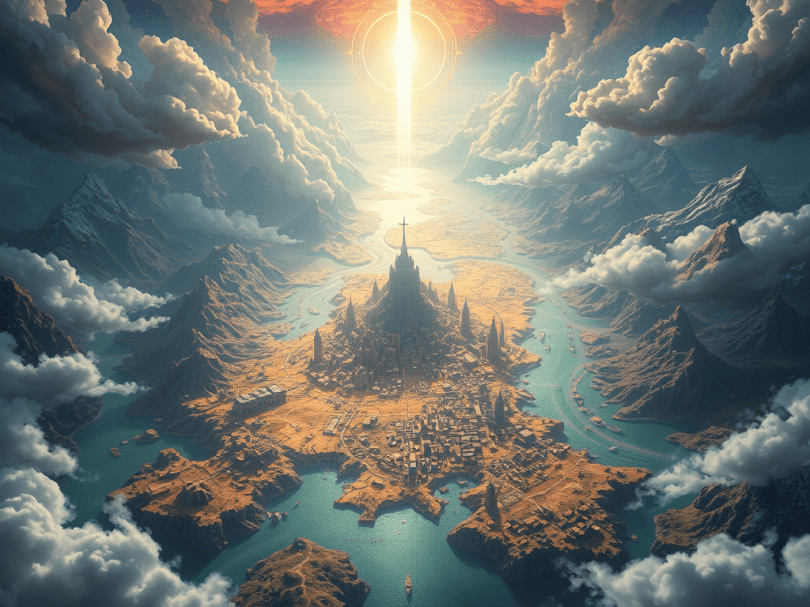

The World of Pillar is the larger moniker I have given to what I assume is going to be a trilogy of books. The first of these has been given the title The Gunslinger and the Beast, with the next in line being titled The Mamon Engine. It might seem odd at first that I know the first two books’ titles, but oddly enough, I am more sure about the second book’s title than I am the first. That is because, currently, the second of the books is nearly done, and the first is about a third of the way done. In the beginning, these first two books were just one volume. However, after hitting just over 110,000 words in the book, I decided it might be better to split the story into two and allow each of the two main narratives to breathe a bit more on their own.
The current plan is to finish this first story and publish it, followed by finishing up the second and publishing it. After those, the third story will combine characters and storylines from the first two as the main story arc concludes. Below, you will find some of the notes on the story and the world I have been playing with. Enjoy this look into the creative process I am working on.
I have envisioned that The World of Pillar is, in fact, Earth far into our future. I have long been a student of the fantasy genre, and many of the classic and modern writings have entertained me for years. When I was in my undergrad, I started reading The Wheel of Time by Robert Jordan and later finished by Brandon Sanderson. It took me years to actually finish the series, not only because it wasn’t finished being written yet, but because it was a very thick tale to move through.
I love Jordan’s fantasy world! While I could never hope to write something on his level, he inspired me greatly. One of the aspects that I really enjoyed was how Randland used to be Earth, but it was in the far future, and the world had been broken to the point that no one remembered it as it had been before. Jordan was sneaky, though, and gave hints throughout the books about the world’s previous status. A lot of the prophecies and histories also provide hints.
When I sat down to write my fantasy, this was a path I wanted my world to trod as well. However, while you really have to look closely at Jordan’s novels, I wanted mine to be fairly obvious if you took the time to really look at the world I was revealing. So, while my text doesn’t come out and say that the world is Earth and nothing overtly yells it out, you can infer the reality of this through many aspects of the story and world. One of the main aspects of this is shown in the map of the surface of Pillar. I created this map and had an artist draw it up from my creations.
Maps and Other Drawings:
The map of Pillar was created using a flood map from the YouTube channel called Worldostats and their video titled USA Flood Map | Sea Level Rise (0-4000 meters). If you watch the video and stop it when the sea level is at 280 meters, you will see the main area of Pillar pop out. I have included a screenshot of the video and placed a grey circle around where Pillar was then pushed up out of the earth, seven miles into the air, after all the flooding.
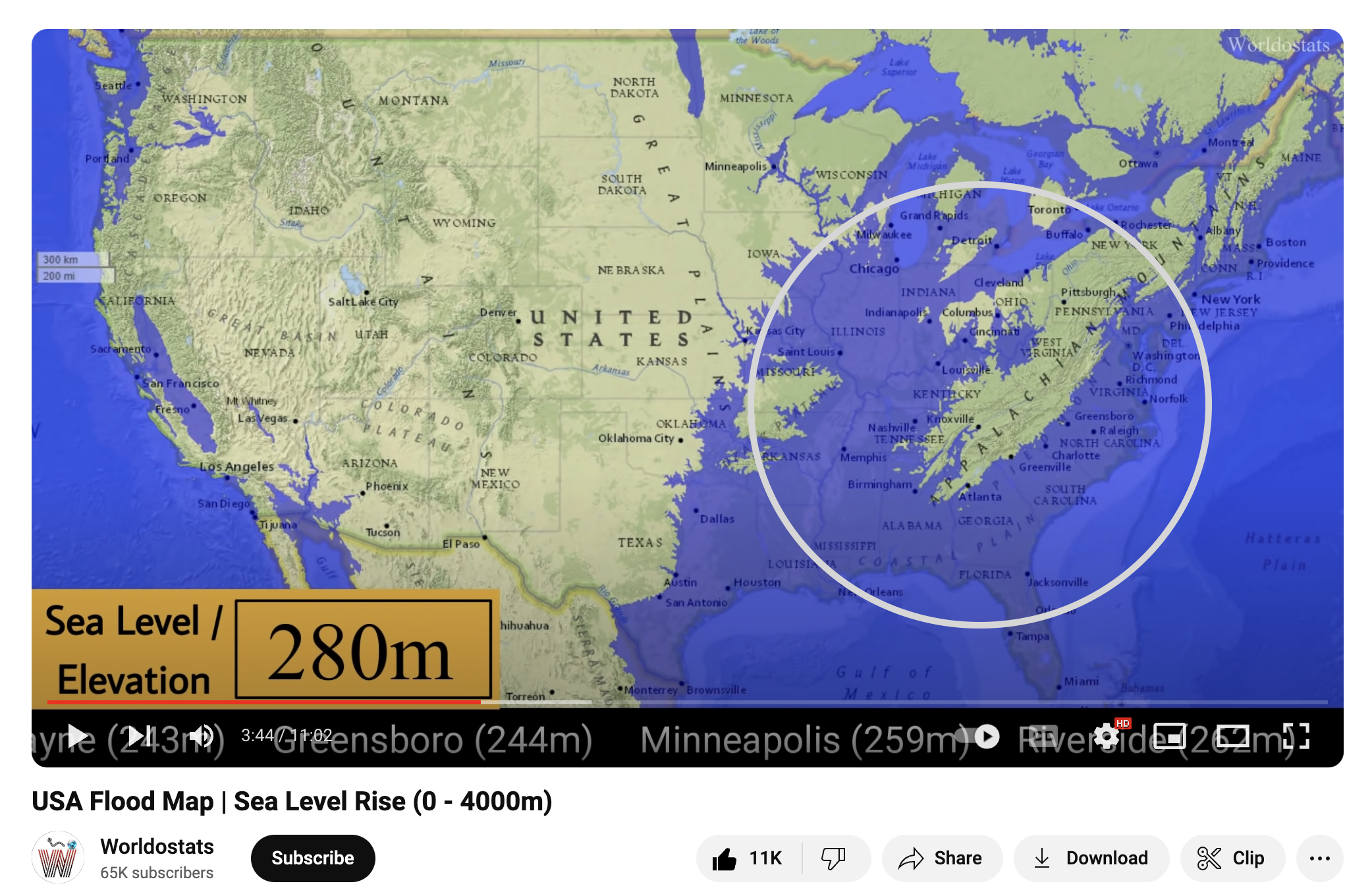
YouTube video from Worldostats, that I paused to create my first map.
I actually laid a piece of tracing paper over my laptop screen to trace the general shape of this map onto paper. Then, once I had the general shape, I bought a full-size map of the eastern coast of the United States and began coloring. In an evening or two, I had a rather large map that I could use to really look into the details of travel and areas that I could play with. It’s interesting to me that with a couple of crayons and a cheap map from Amazon, one can give life to a world that is as vast and intricate as The World of Pillar. Here is that map.
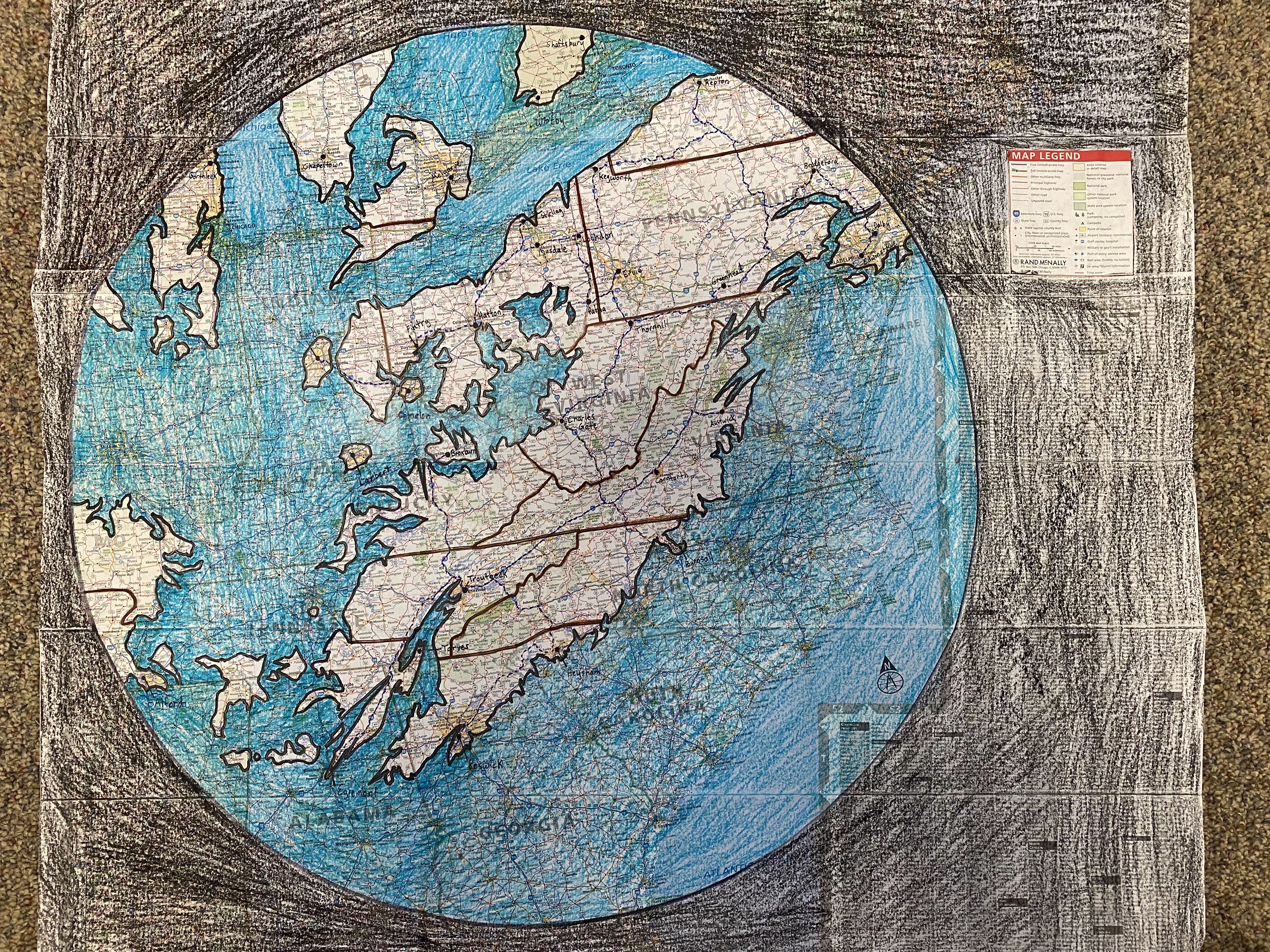
The real world map that I destroyed to create a full-size map of Pillar.
This map hangs above my table downstairs in my basement, where I have written most of the story. Other pictures are hanging in the same place. I photocopied pictures from historical texts from when I was still in college, and other things. There are character sheets and timelines, as well as other drawings of armor, weapons, and even flying ship floor plans.

The folding table in my basement is surrounded by my maps, drawings, and ideas. This is where I do a lot of the writing for my books.
Where did the story come from?
When I was back in college, I had two fantasy stories in my head. One of them was a grand fantasy that would take place on top of a huge pillar up in the sky. I was inspired by the video game Chrono Trigger and the Kingdom of Zeal in the Antiquity timeline. I loved that idea of a place separated from the rest of the world, up in the sky. The other story was a much more personal and down-to-earth fantasy that involved animals in a time far in the future when there were no more humans. This story was going to feature mainly dogs, but also other animals like deer and cats.
In the end, I took both ideas and combined them into a single world and story. The dogs, of course, remain, and the use of other animals as well, but I have chosen to place them into a more grand and far-reaching story in the future, where the creation of a giant plateau in the clouds has nearly destroyed Earth. When the ideas were still new, I first envisioned a female protagonist who was a magic user but never aged beyond twelve. I wanted to play off the idea that wizards were usually frail in physical form but powerful in magic, and using a young girl played into this idea nicely. However, the more I got into the story and started really detailing some of the plot points, the more I got uncomfortable placing a young girl in some of those situations.
I split that character into two separate characters. Thus, the characters of Christoph and Meshiah were born. At the beginning of my writings, Meshiah was a human throughout the story. Still, the more I wrote about her and Schalk (a Brown Dog), the more I really wanted their relationship to be able to blossom into something more than just a friendship. While interspecies relationships are mentioned as being a thing in the world, I didn’t want to directly tackle that sort of ethical difficulty in the main storyline. As such, allowing Meshiah to be changed into a brown dog species in the beginning created a fun narrative beat and also a direct connection to Schalk as a romantic interest in her new life.

The Magic of Creativity:
Magic has captivated me for as long as I can remember. As children, we all dream of possessing powers beyond our reach. I recall a neighbor friend standing on a tree stump, arms outstretched, convinced she could feel herself lift off the ground. She’d rise onto her toes, only to “lose it” and fall back down, claiming she just needed more practice before she could truly fly.
I believe this longing for the fantastic is hardwired into us. Yet, as we grow older and reality settles in, many of us lose touch with that wonder. It’s a tragic loss, really. But there are still moments when we allow ourselves to indulge in that innate desire for magic, like when we become emotionally invested in a great movie, a compelling book, or a great video game.
Take Old Yeller, for example. (Fair warning: spoiler ahead, though the Disney film is over 65 years old, and the book is even older.) In the story, a frontier family faces hardship when the father, Jim, leaves to sell cattle, entrusting his son, Travis, with the responsibility of the household. During Jim’s absence, Travis meets an old yellow dog who proves his worth by saving his younger brother from a bear. Though Travis initially dislikes the dog, their bond grows strong, and eventually, he loves the dog.
At the story’s heart-wrenching climax, Old Yeller fights off a rabid wolf. During that time, there was no cure for rabies. When the dog shows signs of the disease, Travis’ mother hands him a rifle, knowing what has to be done. With a heavy heart, Travis shoots his beloved companion, breaking not only his own heart but the hearts of countless readers and viewers.
However, the story doesn’t end on a hopeless note—Old Yeller had fathered a pup before his tragic end. Though Travis initially resists bonding with the puppy, he eventually recognizes Old Yeller’s spirit in the pup and names him “New Yeller.” My retelling may be simple, but even now, the memory brings tears to my eyes. The emotional impact of a boy having to put down his best friend is a wound many of us still carry, who have seen the film or read the book.
Why do stories like this affect us so deeply? Why do we cry over fictional characters and events? After all, we aren’t the ones forced to kill our beloved pets. Yet, we feel it as if we are. The emotion of it is real.
That’s the magic of storytelling. When we watch a film, read a book, or play a game, we become a part of those worlds. We are Travis Coates. We are Master Chief, Frodo Baggins, Chrono, Rand Althor, or Link. For a time, we embody their struggles and triumphs, feeling every loss and every victory. It’s why we choke up when Samwise Gamgee declares he can’t carry the ring, but that he can carry Frodo, lifting him to his shoulder.
In these moments, we’re not just spectators—we are the heroes. I may never save the world from an evil sorcerer in reality, but through stories, I can be Link, fighting to protect Hyrule from Ganon’s grasp. I’m only a school counselor and author in the real world, but through the boundless creativity of humanity, I can rule kingdoms, save worlds, lose them, and live a thousand lives.
This is the true magic we all possess: the ability to connect to infinite worlds through our imaginations. It’s what makes us truly human. Magic is real—alive in every story we tell, in every fantasy we explore, and in the infinite potential we hold within ourselves.
D. Michl Lowe



 D. Michl Lowe - Author