

Nicodemus, the Librarian of Riggleman Manor, is determined to save the Queen. Having obtained an Opus, he and his fairy, Vellum, are headed to the police station in the city of Charles Gate, to see if they can help.
D. Michl Lowe
Nicodemus, the Librarian of Riggleman Manor, is determined to save the Queen. Having obtained an Opus, he and his fairy, Vellum, are headed to the police station in the city of Charles Gate, to see if they can help.
D. Michl Lowe

Brandon Sanderson, author of books like The Mistborn Saga and the Stormlight Archive Series, is a literal force within the Fantasy genre. He is a machine of creativity and pushes out books faster than his fan base can read. On top of all that, you might think that writing at a pace like that makes his books seem rushed, but they don’t. Brandon’s books are carefully crafted universes with complex characters and detailed plots. In short, he is currently one of my absolute favorite authors. So, let me talk about what I consider his worst book and why I love it so much!
I am nearing the end of Brandon’s first published novel (I think), Elantris. Published in 2005 by Tor Books, this entry into the Cosmere, Brandon’s connected universe of books, is widely regarded as Brandon’s entrance into the world stage as a successful author and his weakest entry overall. Overall, much has been said about the book, but this is not a critique of Elantris as a novel. As is often the case with authors, I constantly compare myself and my writing to those I read.
I have written about it in the past, but authors are notorious for believing their own writing is no good, that no one else will want to read the book they write, or that they are not as good as such and such an author. I am guilty of this, as I am sure many others reading this are as well. Comparison is a natural tendency within writing circles. And as most prolific writers are also prolific readers, it makes sense that they would draw comparisons between themselves and others.
Is this a bad thing? No, of course not. Reading other’s writings and looking at their style, character progression, and world-building is a great way to improve your craft. Reading has opened my mind to the possibilities of creative magic and the possibility of writing. I know this is an old reference, but the video game Myst was very popular back then. The creators of that videogame series, Rand and Robin Miller, along with author David Wingrove, wrote three fantasy novels about it, compiled here as The Myst Reader.
In those books, the characters write in books that bring the worlds they describe to life and allow the person to travel to the worlds they write about. What an interesting analogy to real-life authors and the worlds they create for us to read about. It allows us to travel anywhere the author’s imagination can dream up for us. A gift that continually keeps giving as more and more authors dream and write.
So, why do I say that Brandon’s worst book gives me hope? I started reading Brandon with Mystborn and moved on to the Stormlight Archive soon after. Since then, I have read most of the books of the Cosmere and have come to absolutely love these characters and stories. That said, as I started my first journey into the world of Elantris, I found the characters, magic, and even the world to be a little flat in comparison. Not that the story wasn’t good; it was. It’s not that the characters weren’t well-developed or fun; they were. Not that the magic system wasn’t complex; it was. But, compared to Brandon’s other stories, there was no comparison.
Whenever I read through my own stories, I find all the mistakes and sections I wish were better written. As the author, I am my worst critic. I read things like Oath Bringer, and see the complex characters, detailed plot and completely unique world, and feel like my own characters are flat. My own plot is boring and my own world just isn’t unique enough. If there arent giant crabs attacking magical knights, its just not good enough, but then I read Elantris.
I read Elantris and saw the beginnings of a fantastic author. This first story is a beginning, a stepping stone to what I feel is the greatness of one of my favorite authors. Because of that, I feel like there is hope for me. There is hope for the beginning author, the unpublished, and those still struggling. I see Prince Reoden through his ordeal and understand that my ordeal of being a new author is the same: struggling to find my own magic, my own world, and my own characters. They can be great, even in the beginning phases of creativity. It gives me hope to see Brandon Sanderson’s beginnings and know that I can be there as well. Thanks for your beginnings, Brandon. Thanks for giving us your initial struggles so that we can recognize those struggles in our own writing.
D. Michl Lowe

This recipe yields around 6 quarts of soup and is great canned.
Directions:
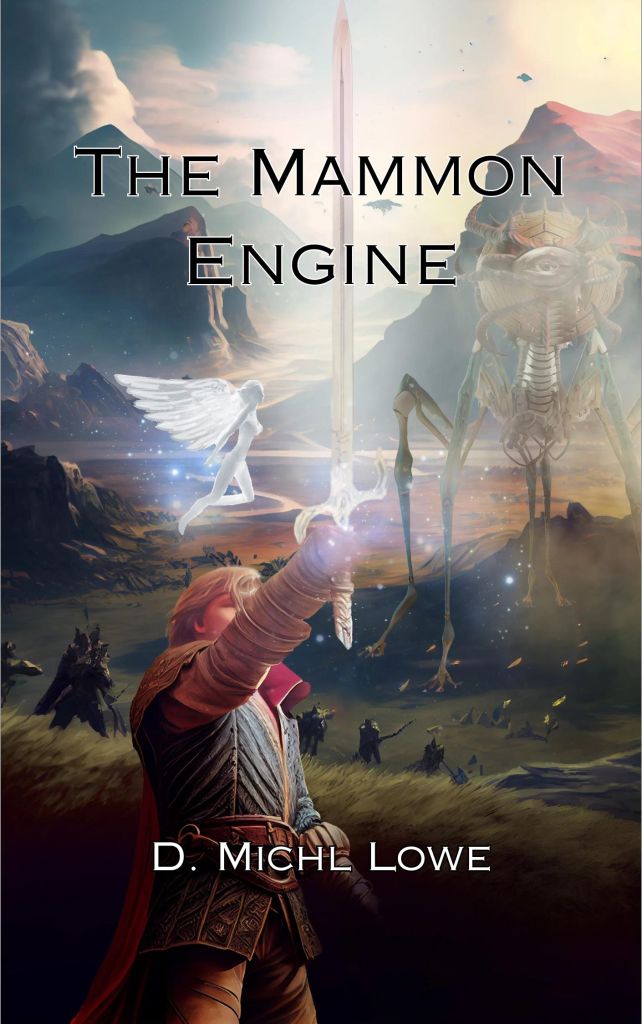
This soup appears in the book The Mammon Engine, by D. Michl Lowe. The character Schalk is fed this soup and comments how he is surprised at how spicy it is, given how clear the broth seems. This is a modified version of River’s Edge Cabbage Soup, which is my personal favorite soup and one that I have been making for years now at home and refining into what you see above. FYI: Schalk is indeed a dog character in the book, but this soup should not be fed to actual dogs, since it contains onions that are toxic to pups. Onions contain a toxic compound known as N-propyl disulfide, which can cause a dog to become anemic if I understand it correctly. Schalk is not a normal dog, even though he may look like one. As anyone who reads the book can attest to.
The book is available for preorder from the button below!
D. Michl Lowe

The first scene of Chapter 27: A Northbound Train
Character Perspective: Bedlam, Balor, and Mentia.
In this first scene, we get to have an insight into a character that is a chimera. This is a creature with the body and head of a lion, another head of a goat, and finally, the tail ends with the head of a snake. We’ve met this character before through the eyes of others, but not from their perspective. I wanted to play around with the aspect of having three persons within the same body and how that would work from a mental perspective and a gender perspective since one of the persons is a female, one is a male, and the other… is something else. This is an evil character within the book, but fascinating for me to write about. Let me know what you think.

Getting himself and the rest of the troops from the Cront’s main city of Creo Tera boarded onto the elevator deep within Pillar had been a trial. It was a large platform elevator, and there needed to be tons of equipment, soldiers, and supplies brought up from the Cront tunnels and onto the surface of Pillar proper. Organizing all of that had taken a lot out of Bedlam. Using Smoke was not taxing within itself, but pulling that much of it from his surroundings had required continual concentration. Keeping the Cront in line and working had proved to be a more difficult job than they had initially thought it would be. The enormous steam engine off to the side of the shaft started up and the platform jumped before beginning the slow ascent towards Pillar above.
Bedlam, Balor, and Mentia were a three-in-one creature. Most of the time, when asked, they just called themselves Bedlam, but in reality, it was more than that. They had the body of a lion, with a tail made of the head of a snake, and beside the lion head, was the slain head of a goat. They had heard someone refer to them as a chimera once, but really that didn’t fully encapsulate what and who they were. Dumont had created Bedlam, all three of him, soon after being awakened. Balor, the goat head of themselves, never really spoke much. She tended to provide the power for whatever Bedlam wanted to do. Occasionally Mentia, the snakehead person, would require some form of Smoke power for something, but they were mostly quiet as well, only occasionally putting in their thoughts or wishes.
It was odd to them that they would occasionally think of themselves as a he or she. Clearly, Bedlam thought of himself as a them, working to consider the whole of themselves, all three. But also, Balor was clearly a she, even without really speaking much. There was a feminine aspect to her thoughts and feelings. Mentia though… Bedlam wasn’t really even sure. he did refer to himself as a “he”, but he was just more of Bedlam, just like Mentia. They were all the same person, not distinct. So, they found themselves thinking of themselves in a fluid state of being. Sometimes a they, sometimes a he, and other times a she. Other times, they were just an it or a thing. Could someone be a they, if they were created by another?
Now the Cront were not that intelligent, not really, but using a hypnotic Smoke on that many of them was challenging. Bedlam would place a renewal of the spell on each of them, every week or so and that seemed to keep them in line and working. As it happened, they only really needed to control the leaders, most of the time. They would then direct the majority of the troops to accomplish the task at hand. That wouldn’t work on the Flemi or on the enlightened races on the surface of Pillar, they were too smart. They would rebel against unjust leaders. He could take control of a single individual, with effort, but it was a chore and took weeks of torture or manipulation to achieve. With the Cront, they didn’t question authority, just went along with it. Convenient that.
The rails on the side of the elevator platform squealed as it continued up. Inside his head, he heard Mentia speaking to him. “We will need to be careful upon the surface,” Mentia said within his mind. “Those above are far more difficult to deal with than those below have been. They will see us as a monster and shy away from us. No one will come to our aid without the help of Dumont.”
He was right of course. There was no other creature within all of Pillar, Bolster Heart, or Creo Tera who came close to being anything like Bedlam. They were unique and that was dangerous in more ways than one. They had been imbued with the ability to use Smoke, just like Dumont, but unlike Demont, they were not a dragon. They were something else. Something the world had never known before. The shaft heading up to the surface of Pillar had not originally been an elevator shaft. Originally, it had been a cloud shaft that led to a cloud tower on the surface. Some years ago, though, the Cront, or maybe more likely early Flemi from Bolster Heart had used that shaft to create this elevator. If it had been the Flemi though, it had long been forgotten. Which was odd, he thought, since traveling the outside stairs was such a troublesome task. If they had remembered this device, it would have made trade and travel between the two lands of Pillar and Bolster Heart much easier.
Dumont had promised Bedlam a place at his side, ruling both of these lands. He had made a lot of promises honestly. So far, many of them had actually come true. The Cront city of Creo Tera was essentially his to rule even now. Looking up, they could see a bright light above them coming closer. As they neared the top of the elevator shaft, the troops began to shuffle about in anticipation. Most of them had never been to the surface, it wasn’t something the Cront typically did. As the platform settled into place, level with the top floor, he saw now the numerous trains, waiting in the tunnels that would be just below the surface of Pillar. They ran across the entirety of the surface but were almost completely unknown to the people who lived up there now. They had built extensive train systems above out in the sun, but these underground trains had been completely forgotten in the years and years after the creation of Pillar. Or so Dumont had claimed.
Bedlam left the elevator platform and walked towards the leading train, green stripped, and tall. At two stories, it dwarfed normal trains on the surface that were only one level. These double-decker trains had wheels on the roofs as well as below them and would ride on the rails below them as well as some above them, once they left this depot. Several Flemi carried their crates and bags for them as they walked over to the train. In the numerous raids, they had taken many slaves. These were easily controlled and made to believe the sun and moon set with him. Over time, they would need less and less Smoke to continue the control. Over time, the spell would just embed itself into their soul and they would just believe their devotion to them was just a normal aspect of who they were. They had always been this way, they would think. It would just make sense to them.
What a nice thought. These ones who needed them so badly could find their true purpose in serving him. At first, before they had really embedded their desires into these others, the others had worried he would eat them. It had made him laugh out loud. The “they” that was Bedlam, Balor, and Mentia could understand the sentiment though, he was part lion of course. But oddly enough, Balor’s appetite for vegetation was the predominant desire they found within themselves. Hay, vegetables, and the occasional fruit was what he desired more than anything else. It was silly when they thought about it, but that’s how it was. They were a creature of three, and each aspect of themselves was equally notable.
D. Michl Lowe

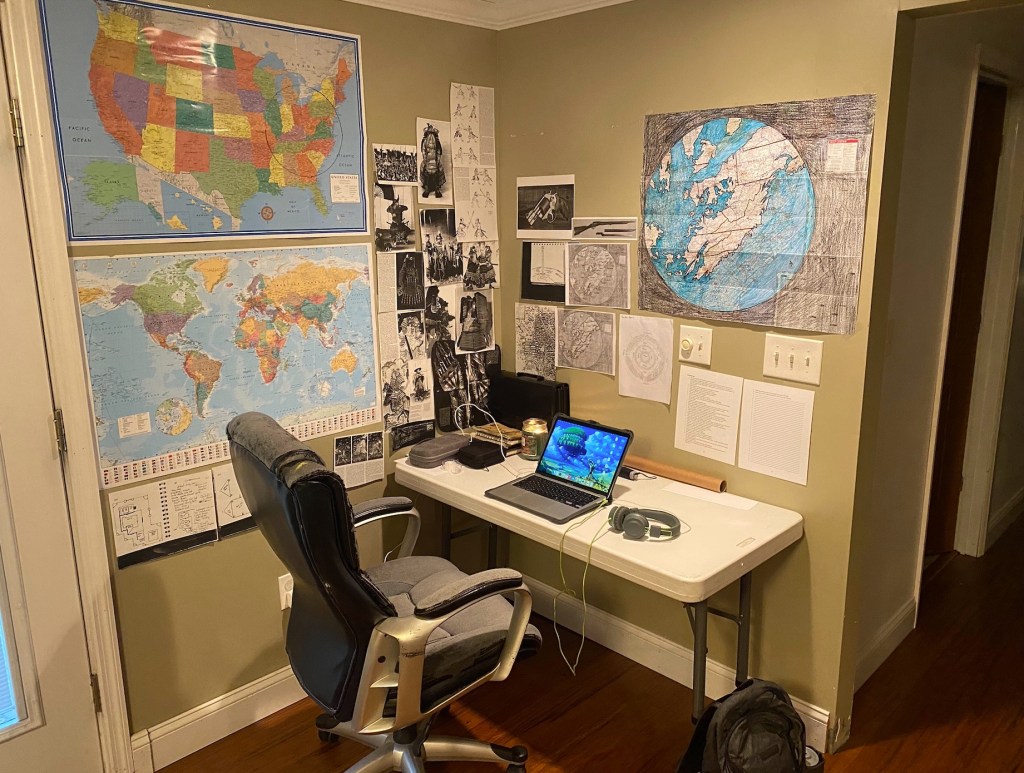
If you look at the picture above, you might be remiss to think I stare at the wall all day and to some degree you would be right. However, the pictures haphazardly taped to the wall around me are all important parts of the creative process from my book. You might not be able to fully tell by looking at it, but the maps have minor and major changes made to them. The one on the right has the most.
The black and white pictures on the left are mostly armor, clothing, and weapons from throughout history. I admit, I would rather have a nice bay window behind my desk to glance out of, but I like my little corner. The temperature is cool down in the basement and at times even quiet. So there’s an allure to the basement space that makes it nearly ideal for a writer.
However, I take some umbrage at saying I don’t have a view. I do have a view. In fact, I have a very unique view. My view is a window into a world where I am God. I don’t say that lightly either. Writing is an interesting pastime. Writers spend a large portion of their lives creating story and character. In other words, they make people who live out lives in worlds of the writer’s creation. Whatever happens to them, at them, by them, all of it, is the design of the writer.
We get to play at being God. I was talking to a new friend of mine and we were discussing different books we had read. This new friend and I suddenly realised we had both read the same book and nearly at the same time exclaimed, “man, that character was messed up!” speaking about a particular character who had a rough life growing up. When we read a story, or watch a movie or tv show, we allow our brains to move us into that reality. We become.part of that world, if for only a little while. It’s a truly magical and wonderful ability we have.
So I do have a view. I view the World of Pillar. The Mammon Engine is not just a book, but a place I feel I watch through the window of the computer screen. I am getting to know the characters of Thistlewart, Dasa, Christoph, Meshiah, Nicodemus, and Schalk. I watch them and listen to them. They speak to each other and in turn, they speak to me. I get to spend to each of them and talk to each of them through the mouths of the other characters. At times, these characters are more real to me than people I see on the news or people I pass on the street. I am intimately aware of Meshiah’s doubt. I feel Thistwart’s shame and Christoph’s anger at God. Dasa’s loss and depression are at times my own. Dasa is pictured below.

Maybe someday, when I finally finish this book, you will fall in love with this world and these peoples as I have. Maybe for you, you will begin to understand why staring at the wall has been so fascinating to me. Maybe you too will feel the shame and anger and adventure I feel. I hope you get that chance, and soon.
D. Michl Lowe
When I have a full-time job…

I work in the school system. It’s a school counselor by day, novelist by night sort of thing. However, it’s more than that. Because of my job, I have more opportunities to write than some, but I feel like everyone can make time for writing a book if they really want to. So, when you are first starting out as a writer and you have a separate full-time job, what do you do to make time to write? Below are some tips I have used to get time in which to write seven books so far.
Utilize a Smart Phone:
I remember seeing Apple’s first press release talking about the first iPhone. I was mesmerized! I knew right then; this thing is going to change everything. It was like a Star Trek communicator had come to life. With that though, today, much of my writing is done on one of these types of devices. The “notes” section of my phone is jammed packed with notes about stories, articles I want to write, and ideas. As well as full sections of chapters that are later transferred over to my main document. This article itself was started on my smartphone. What this allows for is the use of downtime in everyday life. Everyone has moments throughout the day where they have 10 minutes here or there. Normally you might just scroll through Facebook, which I still of course do, but I also use that time to write.
Use Screen Time:
As modern American humans, we use screens a lot. If we aren’t on our phones, we are on our computers. If we aren’t on our computers, we are watching TV or playing video games. Replace some of that general entertainment screen time with writing time. Some of this just seems obvious, but in a lot of ways, writing is just sitting down and doing it. Making the time when you think you don’t have it. Discipline is important. I have actually scheduled time to write on my calendar to make sure I sit down and do it.
Carry a Backpack:
I have a whole ethos dedicated to things I try to keep on my body and carry on my person. If you have never looked on YouTube for the acronym EDC which stands for Everyday Carry. There is a whole subculture that is nearly obsessed with the idea of what is in a person’s pockets. It’s fun if nothing else. That being said, carry a backpack, and in that backpack pack your laptop. Why? I can’t tell you the number of pages I have written while waiting in the doctor’s waiting room, or the dentist’s waiting room. My daughter goes to the Wednesday night church for teen group. My particular church doesn’t offer any classes or groups for adults on Wednesday night, and we live like thirty minutes away from our church, so my going home and coming back is silly. So I spend the time I would normally have been waiting, playing on my phone, or just sitting around; writing. That’s a solid hour and a half of uninterrupted writing time I get every week almost. Bring your laptop with you in your car, in a backpack and you will discover there are a lot of opportunities to write.

Use Vacations Wisely:
When I go on vacation, I try to utilize the experiences in a productive way. I try to experience different things; foods, historic sites, and oddities. A wide array of experiences gives the writer a full template to pull from. I’ve often told other writers to write what they know. When you pull from real things, the writing can come alive in a way that’s often unparalleled. Also, I try to find places to sit and write. For me, that’s a public place with lots of people. I know that’s not a good environment for writing for some people, but for me, that’s ideal. So I have sat on the beach writing, around a pool, in a tropical garden, etc. For me, I have summers and most holidays off due to working in the school system. That is prime time for writing for me. Many days of my summer vacation days are spent down at my local library, sitting at a table and writing.
Create a Writing Space:
In my house, we have three wonderful kids and I have a beautiful wife. These people make life worth living, but they also get in the way of actually getting writing done. So I have set up a little corner in our basement with a plastic table and a chair to set myself apart from the rest of the family. That way when I am there, the kids know what I am doing and tend to let me have my time. A side note: noise-canceling headphones help with that separation. I also talk with my family and explain what I am doing and what my intention is.
So these are just a couple of the ways I work to find time to write when I hold down a full-time job. True, I do have some advantages over others, with having nearly every holiday off and summer vacation, but I think if you take the time to really think about your own time, you will find ways to get it done. J. K. Rowling wrote the original Harry Potter novel while she was a single mom working a full-time job through most of it. That gives me hope. I might not be able to pump out a thousand-page novel in a year like Brandon Sanderson, but I can get my novel done. It just might take me a little longer. Hopefully, I still have years left in my life to devote to this craft. Maybe I can even finish the full story I want to write before I leave this mortal coil. I guess we will see.
D. Michl Lowe

I was part of a writing group for a while. I’m not going to name names, because it’s not important to the story. However, for some time since, I have been scared… of dragons. Let me explain. This was nearly ten years ago and my writing career was still very new. I hadn’t finished my first book, in fact, I hadn’t really even started it yet. However, I was a passionate and ignorant new writer. I was finishing up a master’s degree and would meet with the group at a local coffee shop once a month and submit a passage from the fantasy book I was playing at writing.
One lady was finishing up her second novel in an adventure book series she was writing and I remember being in awe of her. She had a book on Amazon for sale! She was making money from a book she had written! She was, gasp, published! Now, my ignorance at the time was that I didn’t even know that such as thing as self-publishing even existed, much less ideas like vanity publishing and traditional publishing, or writing agents. This was all still a mystery to this newbie, heck, no one knows what they don’t know, and I am most likely still in the dark about many aspects of these things.
I remember she got done reading a short passage I had written in which I had mentioned a dragon. She looked at me and said, “Dragons are on the way out. Publishers won’t publish a story about a dragon because it’s cliche now. Also, never mention a sword, there are too many fantasy stories about magical swords and dragons out there, and you will never get published if you have those things in your story.”
My author admiration was in full effect. She was the only person I had ever met who had finished writing a book, much less had one “published”. Oddly enough, I looked up her book recently and realized that she was self-published through Amazon. Now don’t let me mislead you here, that is still impressive. This is how my books are published as well. However, in my ignorance, her advice to me at the time took on much more significant weight than it should have. After writing three slightly successful books (to me anyway), and now working on my biggest project yet, The Fantasy Book Project, I am ready to admit something. I don’t like her advice. In fact, I am no longer following it. When I first sat down to write out the notes for my world and create the story, her rules of no swords and no dragons were still engrained in my mind, almost unconsciously. I had creatures in my books that I called Beasts, but let’s be honest, as I described them, and inside my head; they were dragons.
Now, none of my characters currently have a sword, but I am not against the idea any longer. The more I read and the newer books I see published, fantasy publishers are only worried about one thing, will the book be bought and read by people. I am one of the biggest fans of traditional, modern, and even odd fantasy and I am not tired of dragons. I like dragons. In fact, you put a dragon on the cover of the book and you have my attention. Throw a Gandalf-looking fella fighting that dragon on the cover and my wallet basically slips out of my pocket on its own.

These ten years into my writing career, here is my writing advice to aspiring writers, for what that is worth.
Let me quickly talk about each of those in a little more detail.
Number 1: Write what you know. Use your own life experiences to create realistic narratives, characters, and situations. Some of the most compelling stories I have read have come from or been inspired by an author’s real-life experiences. I believe this is a great way to write. I follow this advice constantly!
Number 2: Write who you know. Use the people that you know, meet, or get a chance to interact with as subjects to inspire characters in your books. As an example, I read once that Hayao Miyazaki (the famous anime artist) uses real girls he knows as inspiration for the girls he draws in his animes. Also, I remember reading that Charles Dickens did this a lot too. According to the book Mr. Dickens and His Carol, by Samantha Silva, it is a well-known fact that Mr. Dickens kept a notebook full of names he encountered. Apparently, the ghost Jacob Marley was based on a man Mr. Dickens met one time and felt that he was very unpleasant. Ms. Silva tells us that he then wrote down the name and decided that whatever character he turned out to be, he would be dead very quickly. As such, Jacob Marley is dead before the book even starts. Anyway, use real people to give your characters realistic personalities and life, just don’t use the person’s real name. That will get you sued. As it is, I preemptively apologize to all the friends who see themselves in my characters, its not a coincidence.
Number 3: Write what you want. This is the one I am taking for myself. If you want to write about your dog, write about your dog. If you want to write about starships, write about starships. And by goodness, if you want to write about dragons, write about dragons! Don’t allow the fear of being or not being published to scare you off from writing a story you want to write. Write your book and after submitting it to a publisher, if they come back and say they don’t want dragons in your book and can you change it? Heh, there is a “find” option in Microsoft Word where you can find every single instance of a word in your whole document and it’s easy to replace the word “dragon” with “kitten.”
Side Note: Take my advice with a complete grain of salt.
D. Michl Lowe
 D. Michl Lowe - Author