
I Am Not Enough

I’ve concluded that there is apparently something deeply unlikeable and untrustworthy about me. There is a reality of who I am that others must see, that I do not. Maybe those who truly care about me know. Maybe they have tried to tell me. Maybe they have tried to help me understand, and I have stuffed cotton in my ears and closed my eyes to their kindness. Maybe I have been willfully blind to my own shortcomings. Maybe I still am.

For the last couple of years, I had been through over twenty job interviews and had had no luck at all until just recently. For over ten years, I have been nominated for a leadership position but have never been voted into that position. And I don’t blame the voters; I believe they are voting truly and in good faith! It is myself that I see as a failure. It is an observation of my own persona. I would say I am lazy, but really, I don’t think that is it. I value being able to live with the money I make, but I struggle to see my efforts as valuable.

So, is this a depression, then? I assume so. I have heartache and am searching for passion and purpose. I would like to be a true writer, but I have never felt as though I am good enough to truly be called by the title author or writer. Am I proud of my books and writing? Yes, of course, but in the back of my mind, I continually downplay them and question their validity.

I love my family; they give me unending joy and satisfaction, but I feel inadequate at the task of being a father and husband as well. I wonder if this inadequate feeling comes from a lack of my ability to fully support them financially, but then again, maybe it goes beyond that.

I seek purpose in God but feel a failure there as well. I wrote a book in an attempt to harden my devotion and zeal for Christ, but even in all I have done, I feel a failure. As if I should have done more or not done enough. I understand there is continual growth in Christ, and I do see that growth within myself, but then I look back on where I was before. Back then, I thought I was wise, but truly, I was very foolish and didn’t know it. So how am I to believe I am now wise, knowing in ten years I may look back and see my current foolishness for what it is?

They call it a mid-life crisis, but the crisis is a realization of a lifelong inadequacy. How do you make a life worthy? How do you understand what you can change to make it better? There are some things you are locked into, some things that cannot be changed. How do you turn listlessness into motivation and purpose? I don’t trust myself to know that my answers are right.

So what am I to do? Am I meant to meander along, continuing to live in a miasma of stale living? Should I continue to be burdened by a raw and open self-inflicted wound to my ego? Or should I accept the truth, accept the truth that I am not good enough? That I am not worthy of praise? That I am not enough? Because I will never be enough. I can’t do it.

However, when I am weak—because I am weak—He is strong. When I am not enough—and I am not—He is enough. When I am lacking, and I am lacking, He is full and true. When I am down, and I have been down, He is more than enough to raise me up. When I am through with giving effort, and at times, I feel as though I am through, He is there to carry me on.

I am not enough, and I never will be. The reality is no one is enough. No one is truly able. We are all frail and slowly dying, the conscious dead. It is only through the light of Christ we become anything else. In truth, we are only ever meant to be the marionettes of God, allowing the Master to bring us to life and give us His purpose. Am I enough? Yes, but only because I am His. Do I have meaning? Yes, but only the meaning He brings to life within me?

I am the resurrected corpse, Lazarus. I’m stinking but smelling better as the light hits my gaunt face. Undecaying from my death – being brought back into the world of the living, color returning. It is not I who now lives, but Christ who has chosen to live within the destitution of my life, giving it a robust and full justification.

He is worthy, so I am worthy.
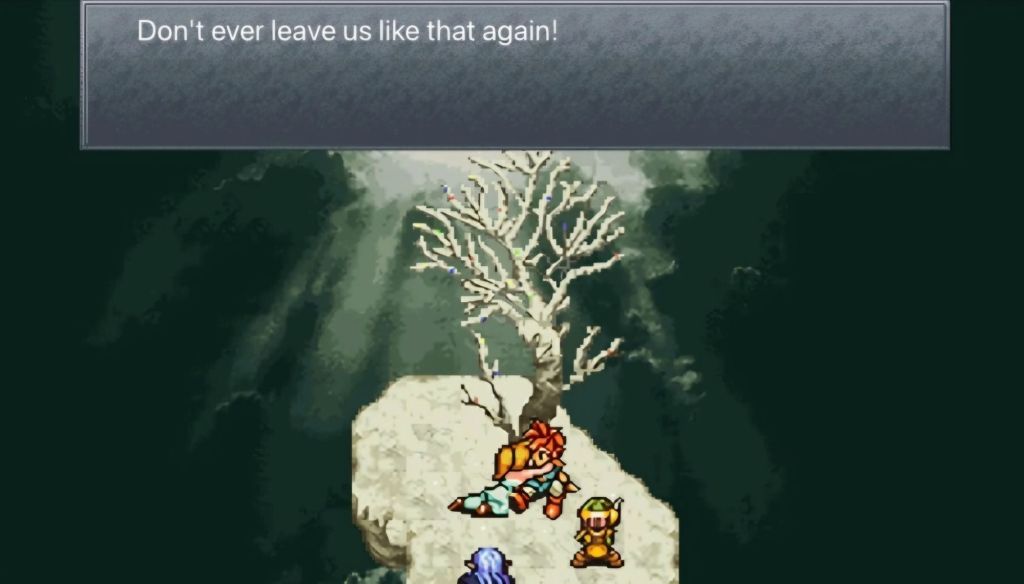
Why I Cry – Every Time – When I Play Chrono Trigger

I’ve written about it previously, but Chrono Trigger played a large part in my childhood. It was my first real RPG and the first game I played with my buddy all night. It was short enough that we could finish it in nearly two sittings, so over the course of the weekend, we were able to beat the game. My buddy didn’t even own the game; he borrowed it from a friend. However, I was hooked. That year, our local videogame rental store, Hollywood Video, was cleaning out its old stock and bringing in new. My birthday was soon, and my mom saw that this game I loved was being sold for cheap at the rental place and bought it for me. It was beat up, but it came with the box and manual.

Nowadays, paying the amount she did for it would be unheard of. I think she might have bought it for twenty dollars at the time. The current going price for a complete in-box with the manual version of the SNES version of Chrono Trigger is around $792.40. Either way, though, I think I valued the gift. It was my favorite game. I played it religiously, playing “new game +” after “new game +.” I grew to know these characters. I cared about them; they were my friends, and I invested in their little virtual lives.

That might sound odd to some people. I say that I cared about them and that they were my “friends.” Why would I feel that way about characters that are not real? Isn’t it the same as reading a book or watching a movie, I hear some of you saying? No, it’s not. The idea of the silent protagonist in this game, Crono, allows the player to insert themselves into the game as a character alongside the other characters. Because Crono doesn’t have any lines himself, he becomes an avatar for the player to place their own will, emotions, and decisions into the game.

Spoilers below for the latter half of Chrono Trigger: you have been warned!

This form of control over the story, even though it is mostly artificial in most cases, allows the player to become more emotionally engaged and involved in the story. The characters are no longer characters outside of the player but meaningful companions with whom the player has gone on adventures with and, in some cases, even died with. As most of you reading this article now know, Crono dies near the end of the game, sacrificing himself in an attempt to save the other companions.

Suddenly, you, the player, are no longer in the story and can witness the sadness and despair your companions feel at the loss of you. This brings about an interesting emotional journey. Like in The Adventures of Tom Sawyer, you are allowed to see that sadness. You become a witness at that point. You are suddenly thrust out of the story and that disconnect makes you feel in some ways as if you have truly died in some way.

It might not be clear from just my writing, but I am, in fact, a man, a 42-year-old man. So my perspectives here are from a decidedly masculine perspective. Several years ago, I wrote a book entitled Men of Valor, a devotional for Christian men. In that book, one of the things I discussed was how men often gravitate toward video games in which they can be the hero, which honestly is many. Men naturally desire to be heroic in some way. Our naturally competitive and aggressive tendencies allow us to, at times, do amazing things. That is in no way meant to diminish the feminine contribution to life; I am just addressing the masculine.

However, life – at least in modern American society – does not often allow for heroic, life-threatening, and life-saving deeds. So, men have turned to artificial means to satisfy those desires. A videogame allows them to experience saving a town from a dragon or, in some more light-hearted situations, to save the Princess from Bowser, even if she is often in another castle. This might be an artificial experience, but the emotions are real.

So that brings me back to Chrono Trigger. After Crono dies, you have two choices, you can choose to leave Crono dead or go on the quest for the Chrono Trigger and use that device to stop time right before Crono is destroyed and save him. You can then replace him with the Crono doll to make it appear as if he was destroyed but really saving him. If you choose to save Crono, and you have Marle (Crono’s love interest), you get the emotional scene pictured above. Depending on who you bring in the party with you to save Crono, the scene changes, but I always take Marle; it just feels right to me.

That hug, as Crono lies back on the tree, brings me to tears every time. It’s a scene that we humans often wish could happen in our real lives—the ability to bring a loved one back from the dead. The player feels that emotion more keenly because we are part of the story. We are Crono. It is not this character we are watching go through something emotional; it is us. We are part of the story.

I know this happens to some degree in all stories, but in video games, and especially in games with silent protagonists like Chrono Trigger, we are the characters, so I would argue that, at times, we feel these emotions more deeply than in a typical entertainment medium. Growing up as a pre-teen, playing this game for the first time it allowed me to explore more mature emotional states and practice the emotional states of loss, love, and sadness in meaningful ways.

So yes, I cry almost every time I play through Chrono Trigger, which is about a once-a-year ritual for me. As a man, there are a lot of times when showing emotions is not acceptable to us. Not because of societal pressures or culture but because of our desire not to allow our emotions to impact those we care about. Showing weakness as a man can often create a feeling of insecurity in those we love. Sure there are times when it’s okay to see Daddy cry, but we often feel like those times should be few in number so as to create stability in our families. Daddy is strong; he can handle the bad times because he is tough. It might not always be correct, but it is how many men feel.

But in the safety of my own little game room, I can allow myself to feel. I can allow myself to connect artificially to my companions in a way that allows those emotions. It allows a man, or anyone really, a free space to feel and be vulnerable. I would argue that there are other good options for men to do this in real life, too, but having this sort of outlet for our feelings is important. I remember when I was a kid, there was a lot of talk about how video games bred violence and social isolation. I believe that view was false. I believe that video games, can and do allow people a safe environment to practice emotional stability and understanding. I don’t have research to back that belief up, but it is my personal belief.

Can it be a problem? Sure, like anything else, we can get overwhelmed by our fantasies and allow them to take over reality. That is a danger. But like many other things in life, I don’t believe this is the norm. I think that, for most men, video games are a way for us to explore ourselves and our relationships. For many of us, the stories and adventures we have shared in this form of entertainment is a meaningful part of our lives.

For me, I always bring Crono back from the dead. Because for me, it’s as if I have been brought back to life each time. I have been given another chance to save the world. I have been given the opportunity to continue to be the hero, even if it is only in a pretend world. In that pretend world, I mattered. In that pretend world, I was a hero. In that pretend world, I was able to create meaningful change. And if I can do it there, maybe I can do it in the real world as well. Maybe I can… and maybe you can too.

D. Michl Lowe

Abortion Is The Man’s Fault

The sin of abortion that is plaguing the world right now, is the fault of men. This crown of death should be laid squarely at our feet. The failure and sin of men have resulted in this unborn holocaust. We are to blame. Our failure in stepping up as fathers has forced the hands of women into accepting the extreme solution of murder. Do our ladies have blood on their hands as well? Of course, but if certain sins could be called worse than others, ours as men is the greater by far.

I am not surprised by the left’s attack on the unborn. It isn’t surprising when evil people support and come up with, evil ideas. However, as I sat there thinking about abortion and what it’s doing to our country, I thought about my own role (or lack thereof) in the death of these millions of children. What should be done? Legislation and voting are important, but how do I respond to this? It’s not like this is a new issue. This was an issue before I was even born.

I can’t help but look at men. Yes, the welfare system and its substitution as the provider have given men an “out”, but that is no excuse. I watch as I see man after man, fading into selfish listlessness. Are there no men left willing to take on the role of father? Sadly, I think fathers are far and few between. Too few men are stepping into the role with the vigor and haste that was the norm in the past. Where are all the warriors ready to live out lives of selfless sacrifice? I think of my own father. The nights he spent driving from one place to another to fix computers; hours and hours on the road servicing computers in three states for General Electric back in the 80s and 90s.

He worked hard. He provided. I am everything I am today because he was a man. A real man. Work wasn’t something that was questionable, it was how he was able to dig himself out of the poverty he was born into. Hard work was how he came to give me and my mom a home, education, and honestly nicer things than we could have ever thought. He wasn’t worried about the next thrill, the next personal ambition, the next woman he could con into his bed. He was worried about making his family better off than the generation he came from. It’s that unselfish ambition for the family that should be pushing and fueling our men.

Beyond even family, Christ calls all men into service for others. A man who takes care of his wife is a man who has a purpose. A man who serves Christ is a man with meaning in his life. It doesn’t take much… be there and be a dad to your kids. Be a husband to your wife. If the relationship doesn’t work out, then realize that your devotion to mom and the kids doesn’t end because you are no longer together. How is Christ calling you to love your ex-wife? How is he calling you to serve her? Even when she is unfair to you. Even when she doesn’t let you see the kids as much as you would like. How does Christ call you to serve her and the kids? I know this is an overly simplistic thought. “It’s not that easy I hear you saying.” I know. I know it’s not that easy, but Christ still calls us to serve and be a man. Being a man is about sacrifice. It’s about learning you aren’t the most important person here. Get up and get your head on straight; be a man.

D. Michl Lowe

Toxic Masculinity

I feel like Rambo is getting a bad rap these days. His way of dealing with problems is frowned upon. There’s no room for blowing stuff up, kicking butt and taking names, or lighting your cigar with the red-hot barrel of an AK47. I jest, but really things that have been seen as manly are largely shunned these days. That’s not to say that Rambo-type stereotypes are all there is to be manly, of course not, but almost anything that might be considered masculine is frowned upon.


The term that is thrown around most of the time is called “toxic masculinity”. Which basically asserts that behaviors, social norms, and ideals that are associated with being masculine are harmful to men, women, and society as a whole. When first introduced by Shepard Bliss in 2017, we see that it wasn’t necessarily a bad term. It was meant to point out some of the negative aspects of society that are most often associated with men; things like rape, physical bullying, sexual assault, and domestic violence. However, in the years following Bliss’ original article and thesis, we have seen this term morph into something beyond Bliss’ original intention.


These days, toxic masculinity has become a catch-all to entrap any overtly masculine appearing behavior and then label it as a problem. Even going so far as demonizing the idea of being a gentleman to a lady. I’ve actually had a woman tell me I insulted her for opening a door for her and allowing her to pass through before myself. As if this simple act of service was insulting to her. As if she couldn’t open the door for herself. It struck me as… odd.

If there is toxic masculinity, which I would argue is just toxic (or maybe sinful?) behavior that is open to both sexes and not just men, then I would say as men and society, we have lost what it means to treat each other and society properly in general. So, I would say it’s not so much toxic masculinity, but toxic behaviors in general that need to be looked at and expunged. In the US and from what I am reading, in many parts of the world, we have lost this idea of service to others and to God.

When Nietzsche declared that “God is dead” back in 1882, he was talking about how the enlightenment period had killed the idea of an all-powerful creator God. Today, I think we have seen that our enlightenment has brought about great good, but also a moral failing as well. Things like equal rights, pulling masses of people out of poverty, and self-government have all been societal goods, but then we look at the selfishness that is so prevalent today and it gives me pause to say that we are completely better off. Our reliance and dependence on our governments have led to us pushing off our responsibilities to family, friends, and neighbors. We allow the government to take care of them. We don’t take the time to talk to people to find out how they are truly doing. We look on Instagram, Facebook, and Twitter to know what’s going on, but fail to dig deeper with those we care about.

Most of our time is spent staring off into the bright glow of meaningless entertainment. Numbing our minds to the emotional plight that is raging around us. My wife recently got a letter in the mail (shocking I know), from a lady at our church. It was a simple typed letter that talked to her about what this lady had been praying for and how she was feeling about my wife’s family and our place in the local church. It wasn’t anything mind-blowing, it wasn’t anything that long or detailed, it was just a moment of connection.

Men are getting the brunt of the harshness. They are prodded, shamed, and pushed into a box that is largely feminine in nature. Now don’t get me wrong, femininity is amazing. I was walking with my wife the other evening and we were talking. She is about halfway through her pregnancy with my first son. He was asleep in her tummy, since to him, he was being gently rocked by his mommy, while she walked for the 30-minute stroll we try to take each night. I told her how beautiful I thought she was. She laughed and said, “I don’t feel like it sometimes right now.” But honestly, seeing my wife carrying my son, she is the most beautiful woman I have ever seen. Masculinity though is meant for men. Just as femininity is meant for women.

Men are meant to be strong.

Not completely in the physical sense, but in general, this should be an aspect that is ascribed to them. I think about that scene from Forest Gump, where Lieutenant Dan has lost his legs and manages to reach up and pull Gump onto the floor to chastise him for saving his life. Throughout the remainder of the film, this seemingly crippled man manages to pull his life back together. I don’t think we would call him an effective warrior any longer and without legs, he wouldn’t be winning any races on his lack of feet, but we would most certainly call him a strong man. Strong in the heart in this case. I think this is often something that is misunderstood. Being emotionally strong means being able to control your emotions. While it is often frowned upon, the father who tells his son not to cry is not trying to distance his son from emotionality, but trying to help them to understand how to control their emotions.

Men are meant to be in control of their emotions.
It’s not that we aren’t emotional beings, we are. But showing those emotions at the wrong time can leave others around us feeling vulnerable and unprotected. There is a comfort in being able to lean on a man who is resolute in his firm understanding of the emotional state of those around him. I rarely saw my own father cry. It was comforting to me as a young boy to know I had a strong and emotionally stable man who was in control of the world I inhabited. I know now that he often felt vulnerable and not up to the tasks at hand, but his outward appearance and stance were always that of confidence and of being in control. I would say that I personally fail at this aspect of masculinity. I cry during movies at the drop of a hat.

Men are meant to be protectors.

There’s often a push to limit violence in men. I understand this to some degree. Violence can become consuming. Allowing ourselves to become obsessed with violence, revel in it, to link it to sexual acts, or enjoy the pain and misery of others is a problem. However, violence in and of itself is not a bad thing. I know that’s a very controversial thing to say, but I truly do believe that in our world’s fallen state, violence is a necessary tool to combat the evil in the world. While I don’t want to go into the issue of transgenderism in this writing, I do think about the recent inclusion of transgendered women (biological men) in sports is very telling. After transgendered women are allowed to compete in women’s sporting events, the record after the record is broken. According to an article on AOL.com by Alex Lasker, “Mary Gregory, an American powerlifter and strength coach, took to Instagram on Sunday to announce she [sic] had gone “9 for 9” at the competition and broken four women’s world records: Masters world squat record, open-world bench record, Masters world deadlift record and Masters world total record.” This man posing as a woman easily smashed world-record-holding women in this sport and we have seen this time and again in many sports.

D. Michl Lowe

The Modern Christian Man

It was 2013, and I was standing behind the register of a local Game Stop. I was still in Grad school for counseling at the time so working at a dead-end job like this gave me what was supposed to be a reprieve from all the studying. Instead, it was one of the best classes on human behavior I could have ever taken.

Let’s get something straight; I like video games. I still play them online with friends. However, working at Game Stop gave me a glimpse into how many men see the world and act upon it. When I say “act upon it” what I really mean is, run from it. I saw men and boys time after time come into the store searching for something. Being a “game advisor” part of my job was to go talk to these people and find out what they were looking for.

Over and over, after speaking with these men, they were looking for meaning. Oh, it would come out in different words than that, but they were always looking for the same thing, purpose, and meaning. Players of World of Warcraft at the time were seeking adventure and a place to belong. Players of Halo wanted to have the feeling of being important in a story. They wanted to know that their actions had an impact; even if that impact was a fictional one.

I find this type of lostness even today. More so maybe. Men continually seek war to wage only to punt on their lives and get lost in meaningless activities. Is it no wonder that we have “man-boys” living in their parent’s basements living out a fantasy where they are the ruler of a kingdom or the hero in some made-up interactive story. It gives the illusion of fulfillment to sex that is starving for it.

So what is the answer? I believe a lot of this comes down to how we choose to raise our sons. Do we call them to action? Do we call them into a purposeful life filled with the challenge of raising a family and providing for them, protecting them? Do we call them to hard work? Creating in them an understanding of purpose through the very sweat of their brow (or exertion of their minds)? We need to be hard on our boys to raise them into the men that Christ has called us to be. To instill respect and meaning through Biblical teaching and the harsh reality of rising to meet the expectations of us, their fathers. No son? No problem. Work to be a man who leads the youth through example. Still a youth yourself? Find a man (hopefully it’s your own dad) who exemplifies what it means to be a man and follow that man!

We can change our country. We can change our world. Be a man who is silken iron; gentle but strong, responsible and hard-working, dependable and honest. It isn’t too late.

D. Michl Lowe