
I Am Not Enough

I’ve concluded that there is apparently something deeply unlikeable and untrustworthy about me. There is a reality of who I am that others must see, that I do not. Maybe those who truly care about me know. Maybe they have tried to tell me. Maybe they have tried to help me understand, and I have stuffed cotton in my ears and closed my eyes to their kindness. Maybe I have been willfully blind to my own shortcomings. Maybe I still am.

For the last couple of years, I had been through over twenty job interviews and had had no luck at all until just recently. For over ten years, I have been nominated for a leadership position but have never been voted into that position. And I don’t blame the voters; I believe they are voting truly and in good faith! It is myself that I see as a failure. It is an observation of my own persona. I would say I am lazy, but really, I don’t think that is it. I value being able to live with the money I make, but I struggle to see my efforts as valuable.

So, is this a depression, then? I assume so. I have heartache and am searching for passion and purpose. I would like to be a true writer, but I have never felt as though I am good enough to truly be called by the title author or writer. Am I proud of my books and writing? Yes, of course, but in the back of my mind, I continually downplay them and question their validity.

I love my family; they give me unending joy and satisfaction, but I feel inadequate at the task of being a father and husband as well. I wonder if this inadequate feeling comes from a lack of my ability to fully support them financially, but then again, maybe it goes beyond that.

I seek purpose in God but feel a failure there as well. I wrote a book in an attempt to harden my devotion and zeal for Christ, but even in all I have done, I feel a failure. As if I should have done more or not done enough. I understand there is continual growth in Christ, and I do see that growth within myself, but then I look back on where I was before. Back then, I thought I was wise, but truly, I was very foolish and didn’t know it. So how am I to believe I am now wise, knowing in ten years I may look back and see my current foolishness for what it is?

They call it a mid-life crisis, but the crisis is a realization of a lifelong inadequacy. How do you make a life worthy? How do you understand what you can change to make it better? There are some things you are locked into, some things that cannot be changed. How do you turn listlessness into motivation and purpose? I don’t trust myself to know that my answers are right.

So what am I to do? Am I meant to meander along, continuing to live in a miasma of stale living? Should I continue to be burdened by a raw and open self-inflicted wound to my ego? Or should I accept the truth, accept the truth that I am not good enough? That I am not worthy of praise? That I am not enough? Because I will never be enough. I can’t do it.

However, when I am weak—because I am weak—He is strong. When I am not enough—and I am not—He is enough. When I am lacking, and I am lacking, He is full and true. When I am down, and I have been down, He is more than enough to raise me up. When I am through with giving effort, and at times, I feel as though I am through, He is there to carry me on.

I am not enough, and I never will be. The reality is no one is enough. No one is truly able. We are all frail and slowly dying, the conscious dead. It is only through the light of Christ we become anything else. In truth, we are only ever meant to be the marionettes of God, allowing the Master to bring us to life and give us His purpose. Am I enough? Yes, but only because I am His. Do I have meaning? Yes, but only the meaning He brings to life within me?

I am the resurrected corpse, Lazarus. I’m stinking but smelling better as the light hits my gaunt face. Undecaying from my death – being brought back into the world of the living, color returning. It is not I who now lives, but Christ who has chosen to live within the destitution of my life, giving it a robust and full justification.

He is worthy, so I am worthy.
Why I Cry – Every Time – When I Play Chrono Trigger

I’ve written about it previously, but Chrono Trigger played a large part in my childhood. It was my first real RPG and the first game I played with my buddy all night. It was short enough that we could finish it in nearly two sittings, so over the course of the weekend, we were able to beat the game. My buddy didn’t even own the game; he borrowed it from a friend. However, I was hooked. That year, our local videogame rental store, Hollywood Video, was cleaning out its old stock and bringing in new. My birthday was soon, and my mom saw that this game I loved was being sold for cheap at the rental place and bought it for me. It was beat up, but it came with the box and manual.

Nowadays, paying the amount she did for it would be unheard of. I think she might have bought it for twenty dollars at the time. The current going price for a complete in-box with the manual version of the SNES version of Chrono Trigger is around $792.40. Either way, though, I think I valued the gift. It was my favorite game. I played it religiously, playing “new game +” after “new game +.” I grew to know these characters. I cared about them; they were my friends, and I invested in their little virtual lives.

That might sound odd to some people. I say that I cared about them and that they were my “friends.” Why would I feel that way about characters that are not real? Isn’t it the same as reading a book or watching a movie, I hear some of you saying? No, it’s not. The idea of the silent protagonist in this game, Crono, allows the player to insert themselves into the game as a character alongside the other characters. Because Crono doesn’t have any lines himself, he becomes an avatar for the player to place their own will, emotions, and decisions into the game.

Spoilers below for the latter half of Chrono Trigger: you have been warned!

This form of control over the story, even though it is mostly artificial in most cases, allows the player to become more emotionally engaged and involved in the story. The characters are no longer characters outside of the player but meaningful companions with whom the player has gone on adventures with and, in some cases, even died with. As most of you reading this article now know, Crono dies near the end of the game, sacrificing himself in an attempt to save the other companions.

Suddenly, you, the player, are no longer in the story and can witness the sadness and despair your companions feel at the loss of you. This brings about an interesting emotional journey. Like in The Adventures of Tom Sawyer, you are allowed to see that sadness. You become a witness at that point. You are suddenly thrust out of the story and that disconnect makes you feel in some ways as if you have truly died in some way.

It might not be clear from just my writing, but I am, in fact, a man, a 42-year-old man. So my perspectives here are from a decidedly masculine perspective. Several years ago, I wrote a book entitled Men of Valor, a devotional for Christian men. In that book, one of the things I discussed was how men often gravitate toward video games in which they can be the hero, which honestly is many. Men naturally desire to be heroic in some way. Our naturally competitive and aggressive tendencies allow us to, at times, do amazing things. That is in no way meant to diminish the feminine contribution to life; I am just addressing the masculine.

However, life – at least in modern American society – does not often allow for heroic, life-threatening, and life-saving deeds. So, men have turned to artificial means to satisfy those desires. A videogame allows them to experience saving a town from a dragon or, in some more light-hearted situations, to save the Princess from Bowser, even if she is often in another castle. This might be an artificial experience, but the emotions are real.

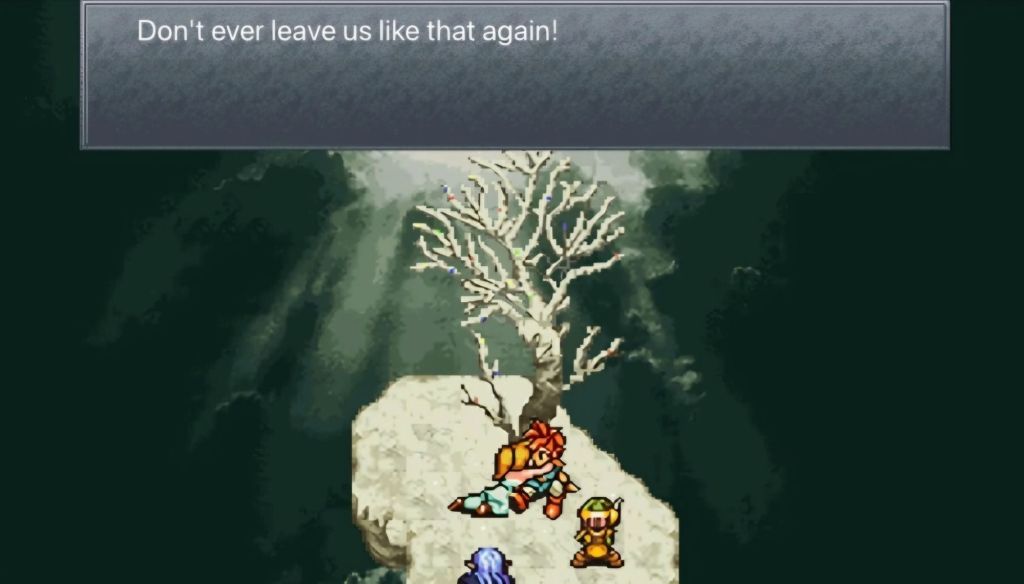
So that brings me back to Chrono Trigger. After Crono dies, you have two choices, you can choose to leave Crono dead or go on the quest for the Chrono Trigger and use that device to stop time right before Crono is destroyed and save him. You can then replace him with the Crono doll to make it appear as if he was destroyed but really saving him. If you choose to save Crono, and you have Marle (Crono’s love interest), you get the emotional scene pictured above. Depending on who you bring in the party with you to save Crono, the scene changes, but I always take Marle; it just feels right to me.

That hug, as Crono lies back on the tree, brings me to tears every time. It’s a scene that we humans often wish could happen in our real lives—the ability to bring a loved one back from the dead. The player feels that emotion more keenly because we are part of the story. We are Crono. It is not this character we are watching go through something emotional; it is us. We are part of the story.

I know this happens to some degree in all stories, but in video games, and especially in games with silent protagonists like Chrono Trigger, we are the characters, so I would argue that, at times, we feel these emotions more deeply than in a typical entertainment medium. Growing up as a pre-teen, playing this game for the first time it allowed me to explore more mature emotional states and practice the emotional states of loss, love, and sadness in meaningful ways.

So yes, I cry almost every time I play through Chrono Trigger, which is about a once-a-year ritual for me. As a man, there are a lot of times when showing emotions is not acceptable to us. Not because of societal pressures or culture but because of our desire not to allow our emotions to impact those we care about. Showing weakness as a man can often create a feeling of insecurity in those we love. Sure there are times when it’s okay to see Daddy cry, but we often feel like those times should be few in number so as to create stability in our families. Daddy is strong; he can handle the bad times because he is tough. It might not always be correct, but it is how many men feel.

But in the safety of my own little game room, I can allow myself to feel. I can allow myself to connect artificially to my companions in a way that allows those emotions. It allows a man, or anyone really, a free space to feel and be vulnerable. I would argue that there are other good options for men to do this in real life, too, but having this sort of outlet for our feelings is important. I remember when I was a kid, there was a lot of talk about how video games bred violence and social isolation. I believe that view was false. I believe that video games, can and do allow people a safe environment to practice emotional stability and understanding. I don’t have research to back that belief up, but it is my personal belief.

Can it be a problem? Sure, like anything else, we can get overwhelmed by our fantasies and allow them to take over reality. That is a danger. But like many other things in life, I don’t believe this is the norm. I think that, for most men, video games are a way for us to explore ourselves and our relationships. For many of us, the stories and adventures we have shared in this form of entertainment is a meaningful part of our lives.

For me, I always bring Crono back from the dead. Because for me, it’s as if I have been brought back to life each time. I have been given another chance to save the world. I have been given the opportunity to continue to be the hero, even if it is only in a pretend world. In that pretend world, I mattered. In that pretend world, I was a hero. In that pretend world, I was able to create meaningful change. And if I can do it there, maybe I can do it in the real world as well. Maybe I can… and maybe you can too.

D. Michl Lowe