

Brandon Sanderson, author of books like The Mistborn Saga and the Stormlight Archive Series, is a literal force within the Fantasy genre. He is a machine of creativity and pushes out books faster than his fan base can read. On top of all that, you might think that writing at a pace like that makes his books seem rushed, but they don’t. Brandon’s books are carefully crafted universes with complex characters and detailed plots. In short, he is currently one of my absolute favorite authors. So, let me talk about what I consider his worst book and why I love it so much!
I am nearing the end of Brandon’s first published novel (I think), Elantris. Published in 2005 by Tor Books, this entry into the Cosmere, Brandon’s connected universe of books, is widely regarded as Brandon’s entrance into the world stage as a successful author and his weakest entry overall. Overall, much has been said about the book, but this is not a critique of Elantris as a novel. As is often the case with authors, I constantly compare myself and my writing to those I read.
I have written about it in the past, but authors are notorious for believing their own writing is no good, that no one else will want to read the book they write, or that they are not as good as such and such an author. I am guilty of this, as I am sure many others reading this are as well. Comparison is a natural tendency within writing circles. And as most prolific writers are also prolific readers, it makes sense that they would draw comparisons between themselves and others.
Is this a bad thing? No, of course not. Reading other’s writings and looking at their style, character progression, and world-building is a great way to improve your craft. Reading has opened my mind to the possibilities of creative magic and the possibility of writing. I know this is an old reference, but the video game Myst was very popular back then. The creators of that videogame series, Rand and Robin Miller, along with author David Wingrove, wrote three fantasy novels about it, compiled here as The Myst Reader.
In those books, the characters write in books that bring the worlds they describe to life and allow the person to travel to the worlds they write about. What an interesting analogy to real-life authors and the worlds they create for us to read about. It allows us to travel anywhere the author’s imagination can dream up for us. A gift that continually keeps giving as more and more authors dream and write.
So, why do I say that Brandon’s worst book gives me hope? I started reading Brandon with Mystborn and moved on to the Stormlight Archive soon after. Since then, I have read most of the books of the Cosmere and have come to absolutely love these characters and stories. That said, as I started my first journey into the world of Elantris, I found the characters, magic, and even the world to be a little flat in comparison. Not that the story wasn’t good; it was. It’s not that the characters weren’t well-developed or fun; they were. Not that the magic system wasn’t complex; it was. But, compared to Brandon’s other stories, there was no comparison.
Whenever I read through my own stories, I find all the mistakes and sections I wish were better written. As the author, I am my worst critic. I read things like Oath Bringer, and see the complex characters, detailed plot and completely unique world, and feel like my own characters are flat. My own plot is boring and my own world just isn’t unique enough. If there arent giant crabs attacking magical knights, its just not good enough, but then I read Elantris.
I read Elantris and saw the beginnings of a fantastic author. This first story is a beginning, a stepping stone to what I feel is the greatness of one of my favorite authors. Because of that, I feel like there is hope for me. There is hope for the beginning author, the unpublished, and those still struggling. I see Prince Reoden through his ordeal and understand that my ordeal of being a new author is the same: struggling to find my own magic, my own world, and my own characters. They can be great, even in the beginning phases of creativity. It gives me hope to see Brandon Sanderson’s beginnings and know that I can be there as well. Thanks for your beginnings, Brandon. Thanks for giving us your initial struggles so that we can recognize those struggles in our own writing.
D. Michl Lowe

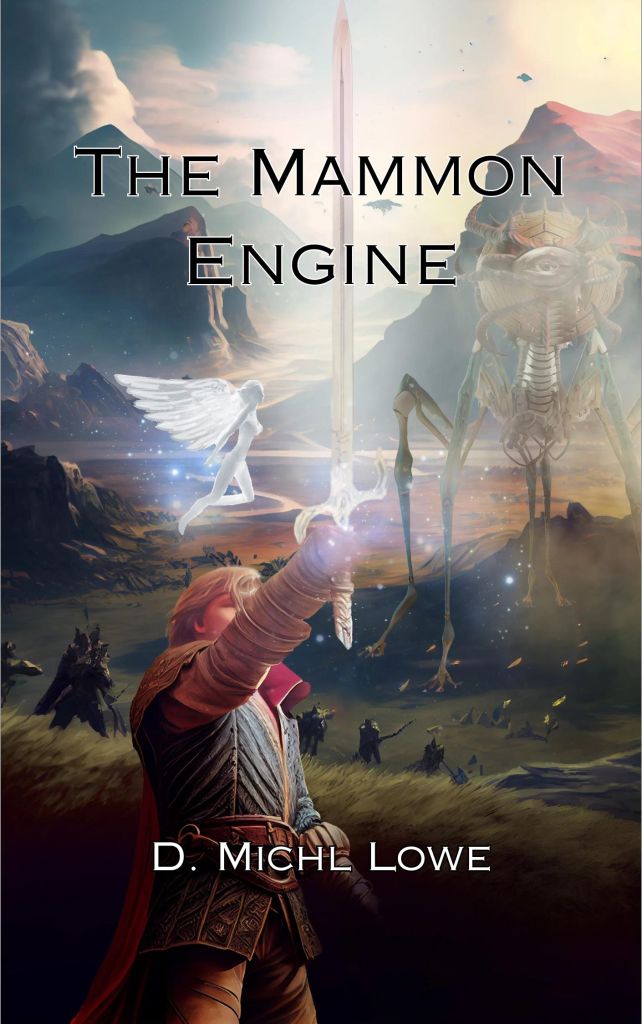
 D. Michl Lowe - Author