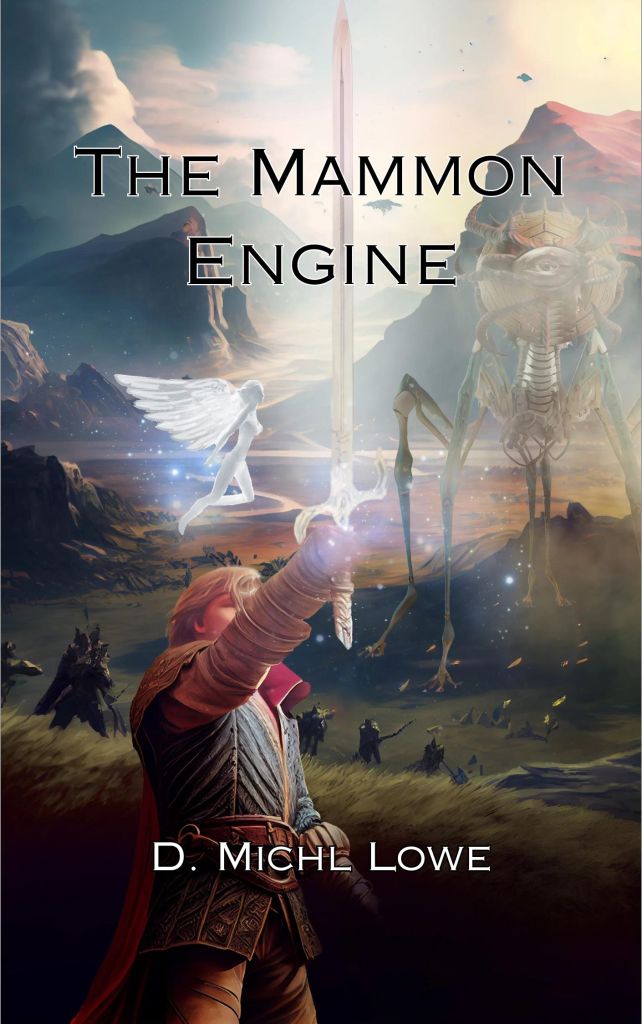
Crafting Fantasy: The Creative Journey Behind The World of Pillar

The World of Pillar is the larger moniker I have given to what I assume is going to be a trilogy of books. The first of these has been given the title The Gunslinger and the Beast, with the next in line being titled The Mamon Engine. It might seem odd at first that I know the first two books’ titles, but oddly enough, I am more sure about the second book’s title than I am the first. That is because, currently, the second of the books is nearly done, and the first is about a third of the way done. In the beginning, these first two books were just one volume. However, after hitting just over 110,000 words in the book, I decided it might be better to split the story into two and allow each of the two main narratives to breathe a bit more on their own.

The current plan is to finish this first story and publish it, followed by finishing up the second and publishing it. After those, the third story will combine characters and storylines from the first two as the main story arc concludes. Below, you will find some of the notes on the story and the world I have been playing with. Enjoy this look into the creative process I am working on.

I have envisioned that The World of Pillar is, in fact, Earth far into our future. I have long been a student of the fantasy genre, and many of the classic and modern writings have entertained me for years. When I was in my undergrad, I started reading The Wheel of Time by Robert Jordan and later finished by Brandon Sanderson. It took me years to actually finish the series, not only because it wasn’t finished being written yet, but because it was a very thick tale to move through.

I love Jordan’s fantasy world! While I could never hope to write something on his level, he inspired me greatly. One of the aspects that I really enjoyed was how Randland used to be Earth, but it was in the far future, and the world had been broken to the point that no one remembered it as it had been before. Jordan was sneaky, though, and gave hints throughout the books about the world’s previous status. A lot of the prophecies and histories also provide hints.

When I sat down to write my fantasy, this was a path I wanted my world to trod as well. However, while you really have to look closely at Jordan’s novels, I wanted mine to be fairly obvious if you took the time to really look at the world I was revealing. So, while my text doesn’t come out and say that the world is Earth and nothing overtly yells it out, you can infer the reality of this through many aspects of the story and world. One of the main aspects of this is shown in the map of the surface of Pillar. I created this map and had an artist draw it up from my creations.

Maps and Other Drawings:

The map of Pillar was created using a flood map from the YouTube channel called Worldostats and their video titled USA Flood Map | Sea Level Rise (0-4000 meters). If you watch the video and stop it when the sea level is at 280 meters, you will see the main area of Pillar pop out. I have included a screenshot of the video and placed a grey circle around where Pillar was then pushed up out of the earth, seven miles into the air, after all the flooding.
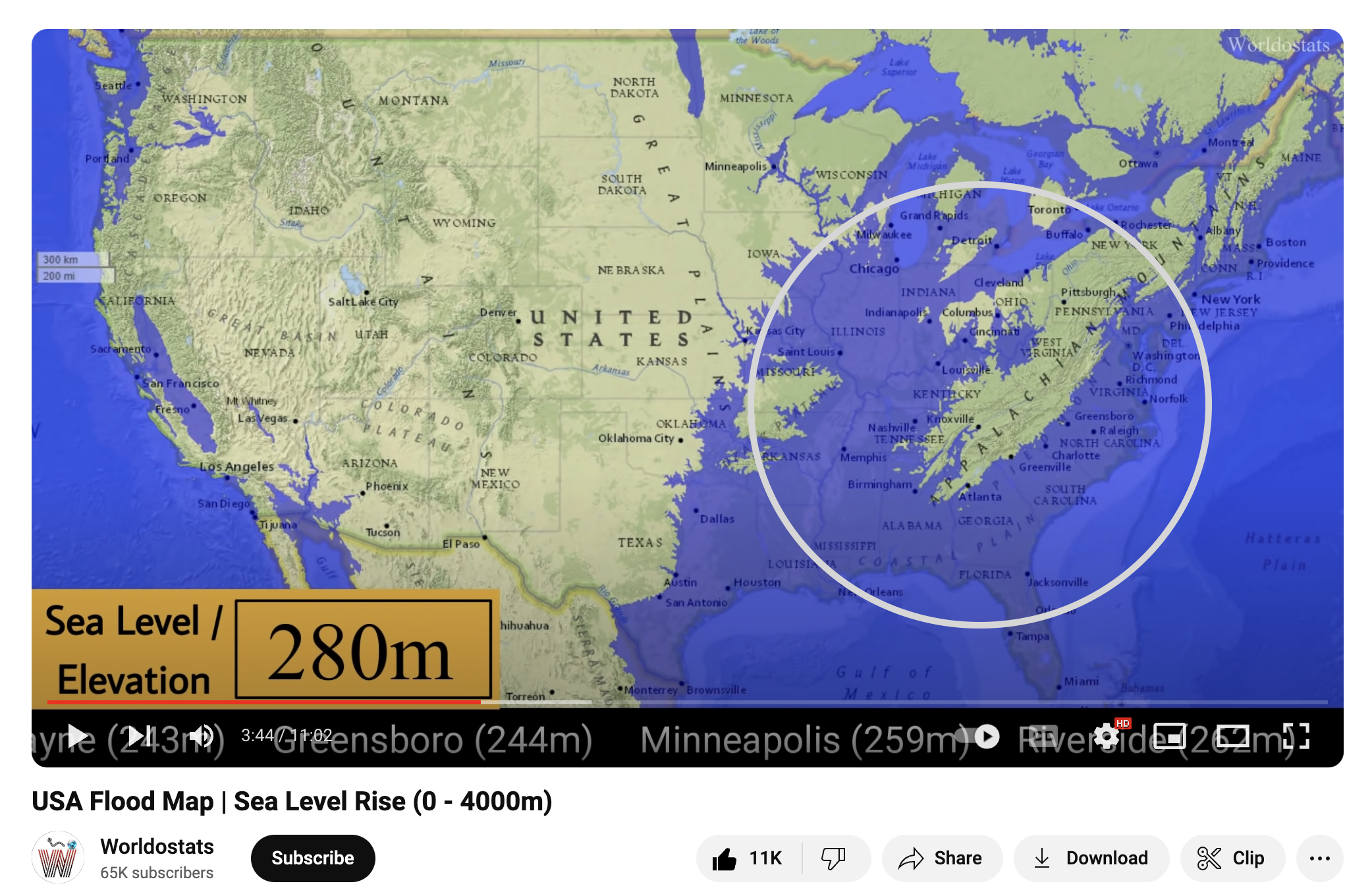
YouTube video from Worldostats, that I paused to create my first map.

I actually laid a piece of tracing paper over my laptop screen to trace the general shape of this map onto paper. Then, once I had the general shape, I bought a full-size map of the eastern coast of the United States and began coloring. In an evening or two, I had a rather large map that I could use to really look into the details of travel and areas that I could play with. It’s interesting to me that with a couple of crayons and a cheap map from Amazon, one can give life to a world that is as vast and intricate as The World of Pillar. Here is that map.
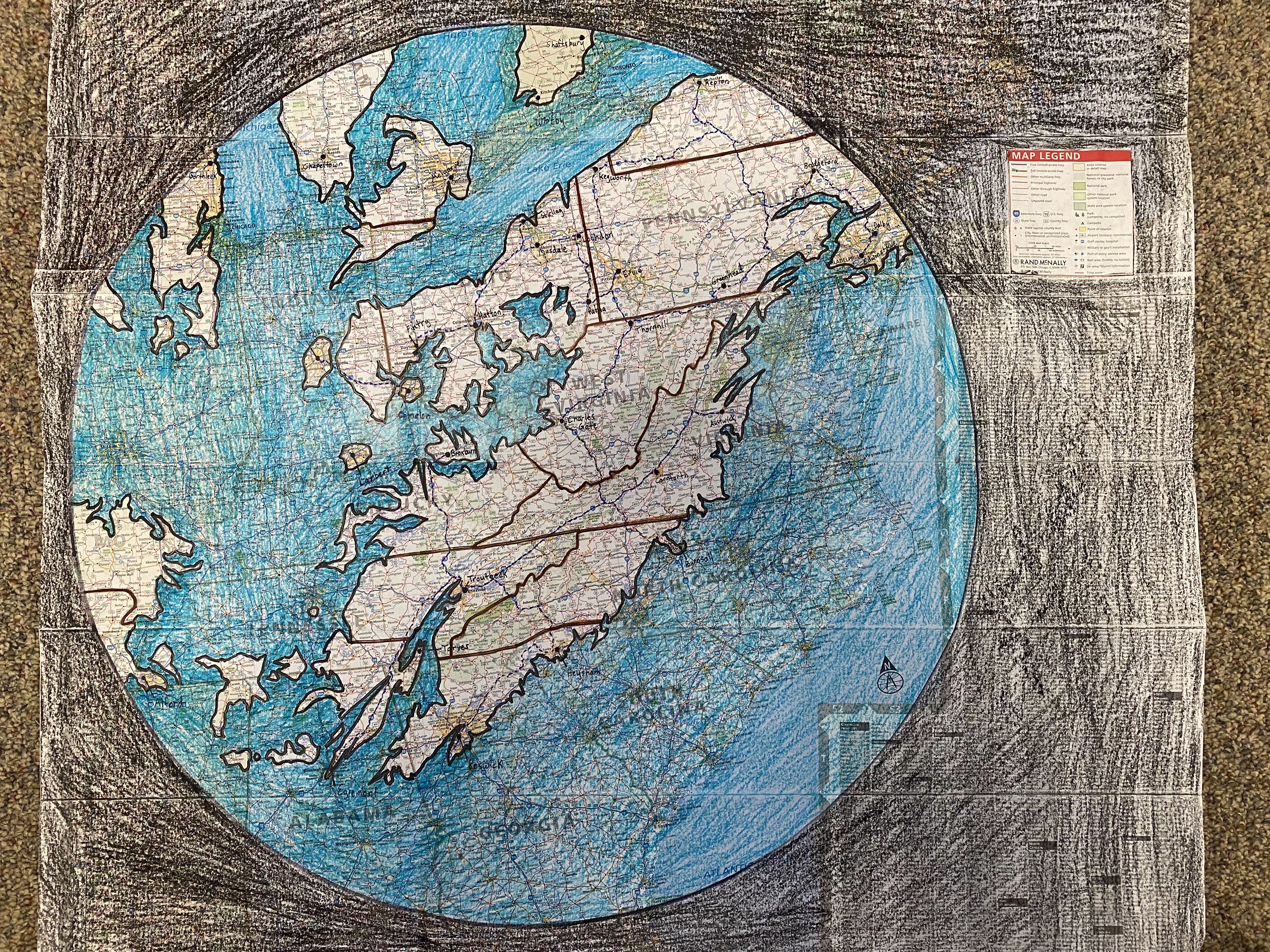
The real world map that I destroyed to create a full-size map of Pillar.

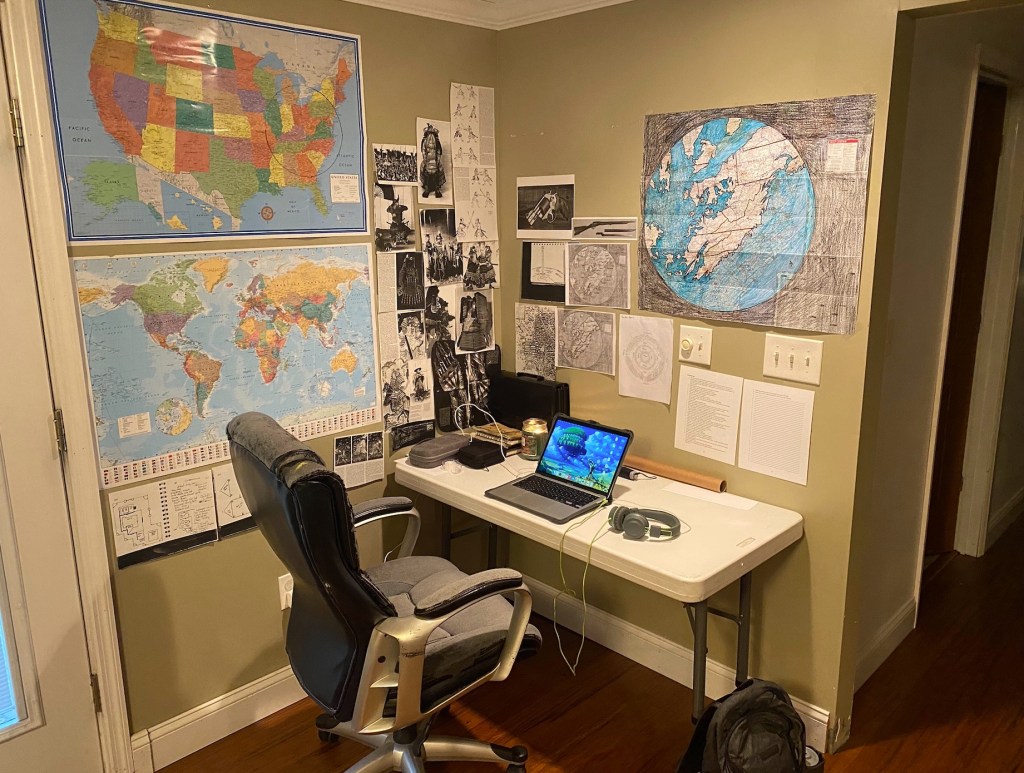
This map hangs above my table downstairs in my basement, where I have written most of the story. Other pictures are hanging in the same place. I photocopied pictures from historical texts from when I was still in college, and other things. There are character sheets and timelines, as well as other drawings of armor, weapons, and even flying ship floor plans.

The folding table in my basement is surrounded by my maps, drawings, and ideas. This is where I do a lot of the writing for my books.

Where did the story come from?

When I was back in college, I had two fantasy stories in my head. One of them was a grand fantasy that would take place on top of a huge pillar up in the sky. I was inspired by the video game Chrono Trigger and the Kingdom of Zeal in the Antiquity timeline. I loved that idea of a place separated from the rest of the world, up in the sky. The other story was a much more personal and down-to-earth fantasy that involved animals in a time far in the future when there were no more humans. This story was going to feature mainly dogs, but also other animals like deer and cats.

In the end, I took both ideas and combined them into a single world and story. The dogs, of course, remain, and the use of other animals as well, but I have chosen to place them into a more grand and far-reaching story in the future, where the creation of a giant plateau in the clouds has nearly destroyed Earth. When the ideas were still new, I first envisioned a female protagonist who was a magic user but never aged beyond twelve. I wanted to play off the idea that wizards were usually frail in physical form but powerful in magic, and using a young girl played into this idea nicely. However, the more I got into the story and started really detailing some of the plot points, the more I got uncomfortable placing a young girl in some of those situations.

I split that character into two separate characters. Thus, the characters of Christoph and Meshiah were born. At the beginning of my writings, Meshiah was a human throughout the story. Still, the more I wrote about her and Schalk (a Brown Dog), the more I really wanted their relationship to be able to blossom into something more than just a friendship. While interspecies relationships are mentioned as being a thing in the world, I didn’t want to directly tackle that sort of ethical difficulty in the main storyline. As such, allowing Meshiah to be changed into a brown dog species in the beginning created a fun narrative beat and also a direct connection to Schalk as a romantic interest in her new life.

Meshiah and Schalk. I commissioned this picture before I switched her to being a Brown Dog.

The Magic of Creativity:

Magic has captivated me for as long as I can remember. As children, we all dream of possessing powers beyond our reach. I recall a neighbor friend standing on a tree stump, arms outstretched, convinced she could feel herself lift off the ground. She’d rise onto her toes, only to “lose it” and fall back down, claiming she just needed more practice before she could truly fly.

I believe this longing for the fantastic is hardwired into us. Yet, as we grow older and reality settles in, many of us lose touch with that wonder. It’s a tragic loss, really. But there are still moments when we allow ourselves to indulge in that innate desire for magic, like when we become emotionally invested in a great movie, a compelling book, or a great video game.

Take Old Yeller, for example. (Fair warning: spoiler ahead, though the Disney film is over 65 years old, and the book is even older.) In the story, a frontier family faces hardship when the father, Jim, leaves to sell cattle, entrusting his son, Travis, with the responsibility of the household. During Jim’s absence, Travis meets an old yellow dog who proves his worth by saving his younger brother from a bear. Though Travis initially dislikes the dog, their bond grows strong, and eventually, he loves the dog.

At the story’s heart-wrenching climax, Old Yeller fights off a rabid wolf. During that time, there was no cure for rabies. When the dog shows signs of the disease, Travis’ mother hands him a rifle, knowing what has to be done. With a heavy heart, Travis shoots his beloved companion, breaking not only his own heart but the hearts of countless readers and viewers.

However, the story doesn’t end on a hopeless note—Old Yeller had fathered a pup before his tragic end. Though Travis initially resists bonding with the puppy, he eventually recognizes Old Yeller’s spirit in the pup and names him “New Yeller.” My retelling may be simple, but even now, the memory brings tears to my eyes. The emotional impact of a boy having to put down his best friend is a wound many of us still carry, who have seen the film or read the book.

Why do stories like this affect us so deeply? Why do we cry over fictional characters and events? After all, we aren’t the ones forced to kill our beloved pets. Yet, we feel it as if we are. The emotion of it is real.

That’s the magic of storytelling. When we watch a film, read a book, or play a game, we become a part of those worlds. We are Travis Coates. We are Master Chief, Frodo Baggins, Chrono, Rand Althor, or Link. For a time, we embody their struggles and triumphs, feeling every loss and every victory. It’s why we choke up when Samwise Gamgee declares he can’t carry the ring, but that he can carry Frodo, lifting him to his shoulder.

In these moments, we’re not just spectators—we are the heroes. I may never save the world from an evil sorcerer in reality, but through stories, I can be Link, fighting to protect Hyrule from Ganon’s grasp. I’m only a school counselor and author in the real world, but through the boundless creativity of humanity, I can rule kingdoms, save worlds, lose them, and live a thousand lives.

This is the true magic we all possess: the ability to connect to infinite worlds through our imaginations. It’s what makes us truly human. Magic is real—alive in every story we tell, in every fantasy we explore, and in the infinite potential we hold within ourselves.

D. Michl Lowe

How Brandon Sanderson Gives Me Hope as an Author

Brandon Sanderson, author of books like The Mistborn Saga and the Stormlight Archive Series, is a literal force within the Fantasy genre. He is a machine of creativity and pushes out books faster than his fan base can read. On top of all that, you might think that writing at a pace like that makes his books seem rushed, but they don’t. Brandon’s books are carefully crafted universes with complex characters and detailed plots. In short, he is currently one of my absolute favorite authors. So, let me talk about what I consider his worst book and why I love it so much!

I am nearing the end of Brandon’s first published novel (I think), Elantris. Published in 2005 by Tor Books, this entry into the Cosmere, Brandon’s connected universe of books, is widely regarded as Brandon’s entrance into the world stage as a successful author and his weakest entry overall. Overall, much has been said about the book, but this is not a critique of Elantris as a novel. As is often the case with authors, I constantly compare myself and my writing to those I read. 

I have written about it in the past, but authors are notorious for believing their own writing is no good, that no one else will want to read the book they write, or that they are not as good as such and such an author. I am guilty of this, as I am sure many others reading this are as well. Comparison is a natural tendency within writing circles. And as most prolific writers are also prolific readers, it makes sense that they would draw comparisons between themselves and others. 

Is this a bad thing? No, of course not. Reading other’s writings and looking at their style, character progression, and world-building is a great way to improve your craft. Reading has opened my mind to the possibilities of creative magic and the possibility of writing. I know this is an old reference, but the video game Myst was very popular back then. The creators of that videogame series, Rand and Robin Miller, along with author David Wingrove, wrote three fantasy novels about it, compiled here as The Myst Reader.

In those books, the characters write in books that bring the worlds they describe to life and allow the person to travel to the worlds they write about. What an interesting analogy to real-life authors and the worlds they create for us to read about. It allows us to travel anywhere the author’s imagination can dream up for us. A gift that continually keeps giving as more and more authors dream and write. 

So, why do I say that Brandon’s worst book gives me hope? I started reading Brandon with Mystborn and moved on to the Stormlight Archive soon after. Since then, I have read most of the books of the Cosmere and have come to absolutely love these characters and stories. That said, as I started my first journey into the world of Elantris, I found the characters, magic, and even the world to be a little flat in comparison. Not that the story wasn’t good; it was. It’s not that the characters weren’t well-developed or fun; they were. Not that the magic system wasn’t complex; it was. But, compared to Brandon’s other stories, there was no comparison. 

Whenever I read through my own stories, I find all the mistakes and sections I wish were better written. As the author, I am my worst critic. I read things like Oath Bringer, and see the complex characters, detailed plot and completely unique world, and feel like my own characters are flat. My own plot is boring and my own world just isn’t unique enough. If there arent giant crabs attacking magical knights, its just not good enough, but then I read Elantris.

I read Elantris and saw the beginnings of a fantastic author. This first story is a beginning, a stepping stone to what I feel is the greatness of one of my favorite authors. Because of that, I feel like there is hope for me. There is hope for the beginning author, the unpublished, and those still struggling. I see Prince Reoden through his ordeal and understand that my ordeal of being a new author is the same: struggling to find my own magic, my own world, and my own characters. They can be great, even in the beginning phases of creativity. It gives me hope to see Brandon Sanderson’s beginnings and know that I can be there as well. Thanks for your beginnings, Brandon. Thanks for giving us your initial struggles so that we can recognize those struggles in our own writing.

D. Michl Lowe

Schalk’s Cabbage Soup

This recipe yields around 6 quarts of soup and is great canned.

  • 1 medium-sized cabbage chopped into 1-inch squares, (or enough to fill the bottom of the pot several inches up with chopped cabbage).
  • 5-6 stalks of celery (enough to cover the top of the cabbage), chopped thin.
  • 1 large white onion, cut into medium chunks.
  • 1 (28-ounce) can of crushed tomatoes.
  • 8 ounces of tomato juice or V8.
  • 1.5 tablespoons salt.
  • 1 teaspoon of black pepper or white pepper, if you want a cleaner look.
  • 1/2 a teaspoon of crushed red pepper.
  • 1 small carrot
  • 1 small jalapeno

Directions:

  • 1. Put your cabbage in a large steep-sided pot, enough to hold all the ingredients.
  • 2. Put the chopped celery into the pot on top of the cabbage. I usually just do a rough chop to the size I want.
  • 3. Cut your onion into medium chunks and place this on top of the celery.
  • 4. Fill the pot up with water so that it covers the cabbage, celery, and onion a good 5 inches.
  • 5. Place the pot on the stove and bring it to a boil. Reduce the heat just enough to keep it at a steady simmer and cook until the cabbage, celery, and onion are tender but still firm; around 35 minutes.
  • 6. Then add the remaining ingredients (crushed tomatoes, tomato juice, salt, pepper, and crushed red pepper) and cook an additional 5 minutes to allow the ingredients to get to know one another.
  • Remove from the heat and serve.

This soup appears in the book The Mammon Engine, by D. Michl Lowe. The character Schalk is fed this soup and comments how he is surprised at how spicy it is, given how clear the broth seems. This is a modified version of River’s Edge Cabbage Soup, which is my personal favorite soup and one that I have been making for years now at home and refining into what you see above. FYI: Schalk is indeed a dog character in the book, but this soup should not be fed to actual dogs, since it contains onions that are toxic to pups. Onions contain a toxic compound known as N-propyl disulfide, which can cause a dog to become anemic if I understand it correctly. Schalk is not a normal dog, even though he may look like one. As anyone who reads the book can attest to.

The book is available for preorder from the button below!

PREORDER HERE!

PREORDER HERE!

D. Michl Lowe

The Mammon Engine: Ch: 27

The first scene of Chapter 27: A Northbound Train

Character Perspective: Bedlam, Balor, and Mentia.

In this first scene, we get to have an insight into a character that is a chimera. This is a creature with the body and head of a lion, another head of a goat, and finally, the tail ends with the head of a snake. We’ve met this character before through the eyes of others, but not from their perspective. I wanted to play around with the aspect of having three persons within the same body and how that would work from a mental perspective and a gender perspective since one of the persons is a female, one is a male, and the other… is something else. This is an evil character within the book, but fascinating for me to write about. Let me know what you think.

Getting himself and the rest of the troops from the Cront’s main city of Creo Tera boarded onto the elevator deep within Pillar had been a trial. It was a large platform elevator, and there needed to be tons of equipment, soldiers, and supplies brought up from the Cront tunnels and onto the surface of Pillar proper. Organizing all of that had taken a lot out of Bedlam. Using Smoke was not taxing within itself, but pulling that much of it from his surroundings had required continual concentration. Keeping the Cront in line and working had proved to be a more difficult job than they had initially thought it would be. The enormous steam engine off to the side of the shaft started up and the platform jumped before beginning the slow ascent towards Pillar above.

Bedlam, Balor, and Mentia were a three-in-one creature. Most of the time, when asked, they just called themselves Bedlam, but in reality, it was more than that. They had the body of a lion, with a tail made of the head of a snake, and beside the lion head, was the slain head of a goat. They had heard someone refer to them as a chimera once, but really that didn’t fully encapsulate what and who they were. Dumont had created Bedlam, all three of him, soon after being awakened. Balor, the goat head of themselves, never really spoke much. She tended to provide the power for whatever Bedlam wanted to do. Occasionally Mentia, the snakehead person, would require some form of Smoke power for something, but they were mostly quiet as well, only occasionally putting in their thoughts or wishes.

It was odd to them that they would occasionally think of themselves as a he or she. Clearly, Bedlam thought of himself as a them, working to consider the whole of themselves, all three. But also, Balor was clearly a she, even without really speaking much. There was a feminine aspect to her thoughts and feelings. Mentia though… Bedlam wasn’t really even sure. he did refer to himself as a “he”, but he was just more of Bedlam, just like Mentia. They were all the same person, not distinct. So, they found themselves thinking of themselves in a fluid state of being. Sometimes a they, sometimes a he, and other times a she. Other times, they were just an it or a thing. Could someone be a they, if they were created by another?

Now the Cront were not that intelligent, not really, but using a hypnotic Smoke on that many of them was challenging. Bedlam would place a renewal of the spell on each of them, every week or so and that seemed to keep them in line and working. As it happened, they only really needed to control the leaders, most of the time. They would then direct the majority of the troops to accomplish the task at hand. That wouldn’t work on the Flemi or on the enlightened races on the surface of Pillar, they were too smart. They would rebel against unjust leaders. He could take control of a single individual, with effort, but it was a chore and took weeks of torture or manipulation to achieve. With the Cront, they didn’t question authority, just went along with it. Convenient that.

The rails on the side of the elevator platform squealed as it continued up. Inside his head, he heard Mentia speaking to him. “We will need to be careful upon the surface,” Mentia said within his mind. “Those above are far more difficult to deal with than those below have been. They will see us as a monster and shy away from us. No one will come to our aid without the help of Dumont.”

He was right of course. There was no other creature within all of Pillar, Bolster Heart, or Creo Tera who came close to being anything like Bedlam. They were unique and that was dangerous in more ways than one. They had been imbued with the ability to use Smoke, just like Dumont, but unlike Demont, they were not a dragon. They were something else. Something the world had never known before. The shaft heading up to the surface of Pillar had not originally been an elevator shaft. Originally, it had been a cloud shaft that led to a cloud tower on the surface. Some years ago, though, the Cront, or maybe more likely early Flemi from Bolster Heart had used that shaft to create this elevator. If it had been the Flemi though, it had long been forgotten. Which was odd, he thought, since traveling the outside stairs was such a troublesome task. If they had remembered this device, it would have made trade and travel between the two lands of Pillar and Bolster Heart much easier.

Dumont had promised Bedlam a place at his side, ruling both of these lands. He had made a lot of promises honestly. So far, many of them had actually come true. The Cront city of Creo Tera was essentially his to rule even now. Looking up, they could see a bright light above them coming closer. As they neared the top of the elevator shaft, the troops began to shuffle about in anticipation. Most of them had never been to the surface, it wasn’t something the Cront typically did. As the platform settled into place, level with the top floor, he saw now the numerous trains, waiting in the tunnels that would be just below the surface of Pillar. They ran across the entirety of the surface but were almost completely unknown to the people who lived up there now. They had built extensive train systems above out in the sun, but these underground trains had been completely forgotten in the years and years after the creation of Pillar. Or so Dumont had claimed.

Bedlam left the elevator platform and walked towards the leading train, green stripped, and tall. At two stories, it dwarfed normal trains on the surface that were only one level. These double-decker trains had wheels on the roofs as well as below them and would ride on the rails below them as well as some above them, once they left this depot. Several Flemi carried their crates and bags for them as they walked over to the train. In the numerous raids, they had taken many slaves. These were easily controlled and made to believe the sun and moon set with him. Over time, they would need less and less Smoke to continue the control. Over time, the spell would just embed itself into their soul and they would just believe their devotion to them was just a normal aspect of who they were. They had always been this way, they would think. It would just make sense to them.

What a nice thought. These ones who needed them so badly could find their true purpose in serving him. At first, before they had really embedded their desires into these others, the others had worried he would eat them. It had made him laugh out loud. The “they” that was Bedlam, Balor, and Mentia could understand the sentiment though, he was part lion of course. But oddly enough, Balor’s appetite for vegetation was the predominant desire they found within themselves. Hay, vegetables, and the occasional fruit was what he desired more than anything else. It was silly when they thought about it, but that’s how it was. They were a creature of three, and each aspect of themselves was equally notable.

D. Michl Lowe

Looking Through the Window that’s Not Really There

If you look at the picture above, you might be remiss to think I stare at the wall all day and to some degree you would be right. However, the pictures haphazardly taped to the wall around me are all important parts of the creative process from my book. You might not be able to fully tell by looking at it, but the maps have minor and major changes made to them. The one on the right has the most.

The black and white pictures on the left are mostly armor, clothing, and weapons from throughout history. I admit, I would rather have a nice bay window behind my desk to glance out of, but I like my little corner. The temperature is cool down in the basement and at times even quiet. So there’s an allure to the basement space that makes it nearly ideal for a writer.

However, I take some umbrage at saying I don’t have a view. I do have a view. In fact, I have a very unique view. My view is a window into a world where I am God. I don’t say that lightly either. Writing is an interesting pastime. Writers spend a large portion of their lives creating story and character. In other words, they make people who live out lives in worlds of the writer’s creation. Whatever happens to them, at them, by them, all of it, is the design of the writer.

We get to play at being God. I was talking to a new friend of mine and we were discussing different books we had read. This new friend and I suddenly realised we had both read the same book and nearly at the same time exclaimed, “man, that character was messed up!” speaking about a particular character who had a rough life growing up. When we read a story, or watch a movie or tv show, we allow our brains to move us into that reality. We become.part of that world, if for only a little while. It’s a truly magical and wonderful ability we have.

So I do have a view. I view the World of Pillar. The Mammon Engine is not just a book, but a place I feel I watch through the window of the computer screen. I am getting to know the characters of Thistlewart, Dasa, Christoph, Meshiah, Nicodemus, and Schalk. I watch them and listen to them. They speak to each other and in turn, they speak to me. I get to spend to each of them and talk to each of them through the mouths of the other characters. At times, these characters are more real to me than people I see on the news or people I pass on the street. I am intimately aware of Meshiah’s doubt. I feel Thistwart’s shame and Christoph’s anger at God. Dasa’s loss and depression are at times my own. Dasa is pictured below.

Maybe someday, when I finally finish this book, you will fall in love with this world and these peoples as I have. Maybe for you, you will begin to understand why staring at the wall has been so fascinating to me. Maybe you too will feel the shame and anger and adventure I feel. I hope you get that chance, and soon.

D. Michl Lowe

How I Find Time to Write

When I have a full-time job…

I work in the school system. It’s a school counselor by day, novelist by night sort of thing. However, it’s more than that. Because of my job, I have more opportunities to write than some, but I feel like everyone can make time for writing a book if they really want to. So, when you are first starting out as a writer and you have a separate full-time job, what do you do to make time to write? Below are some tips I have used to get time in which to write seven books so far.

Utilize a Smart Phone: 

I remember seeing Apple’s first press release talking about the first iPhone. I was mesmerized! I knew right then; this thing is going to change everything. It was like a Star Trek communicator had come to life. With that though, today, much of my writing is done on one of these types of devices. The “notes” section of my phone is jammed packed with notes about stories, articles I want to write, and ideas. As well as full sections of chapters that are later transferred over to my main document. This article itself was started on my smartphone. What this allows for is the use of downtime in everyday life. Everyone has moments throughout the day where they have 10 minutes here or there. Normally you might just scroll through Facebook, which I still of course do, but I also use that time to write. 

Use Screen Time:

As modern American humans, we use screens a lot. If we aren’t on our phones, we are on our computers. If we aren’t on our computers, we are watching TV or playing video games. Replace some of that general entertainment screen time with writing time. Some of this just seems obvious, but in a lot of ways, writing is just sitting down and doing it. Making the time when you think you don’t have it. Discipline is important. I have actually scheduled time to write on my calendar to make sure I sit down and do it.

Carry a Backpack:

I have a whole ethos dedicated to things I try to keep on my body and carry on my person. If you have never looked on YouTube for the acronym EDC which stands for Everyday Carry. There is a whole subculture that is nearly obsessed with the idea of what is in a person’s pockets. It’s fun if nothing else. That being said, carry a backpack, and in that backpack pack your laptop. Why? I can’t tell you the number of pages I have written while waiting in the doctor’s waiting room, or the dentist’s waiting room. My daughter goes to the Wednesday night church for teen group. My particular church doesn’t offer any classes or groups for adults on Wednesday night, and we live like thirty minutes away from our church, so my going home and coming back is silly. So I spend the time I would normally have been waiting, playing on my phone, or just sitting around; writing. That’s a solid hour and a half of uninterrupted writing time I get every week almost. Bring your laptop with you in your car, in a backpack and you will discover there are a lot of opportunities to write.

Use Vacations Wisely:

When I go on vacation, I try to utilize the experiences in a productive way. I try to experience different things; foods, historic sites, and oddities. A wide array of experiences gives the writer a full template to pull from. I’ve often told other writers to write what they know. When you pull from real things, the writing can come alive in a way that’s often unparalleled. Also, I try to find places to sit and write. For me, that’s a public place with lots of people. I know that’s not a good environment for writing for some people, but for me, that’s ideal. So I have sat on the beach writing, around a pool, in a tropical garden, etc. For me, I have summers and most holidays off due to working in the school system. That is prime time for writing for me. Many days of my summer vacation days are spent down at my local library, sitting at a table and writing. 

Create a Writing Space: 

In my house, we have three wonderful kids and I have a beautiful wife. These people make life worth living, but they also get in the way of actually getting writing done. So I have set up a little corner in our basement with a plastic table and a chair to set myself apart from the rest of the family. That way when I am there, the kids know what I am doing and tend to let me have my time. A side note: noise-canceling headphones help with that separation. I also talk with my family and explain what I am doing and what my intention is. 

So these are just a couple of the ways I work to find time to write when I hold down a full-time job. True, I do have some advantages over others, with having nearly every holiday off and summer vacation, but I think if you take the time to really think about your own time, you will find ways to get it done. J. K. Rowling wrote the original Harry Potter novel while she was a single mom working a full-time job through most of it. That gives me hope. I might not be able to pump out a thousand-page novel in a year like Brandon Sanderson, but I can get my novel done. It just might take me a little longer. Hopefully, I still have years left in my life to devote to this craft. Maybe I can even finish the full story I want to write before I leave this mortal coil. I guess we will see.

D. Michl Lowe

Being an Author with ADD

As a writer, I am often split in my attention. While I might be talking to someone or doing a task, my brain is always going over some aspect of my book. Maybe I am considering some part of the world of the book, here recently that’s been the magic system and religions of the people there. How do those things work? Why are they the way they are? Who are the major characters which will interact with those aspects of the world? How will the plot play into these things I am thinking up? All these types of questions are constantly running back and forth in my brain. I even dream about these things. The other night, I woke up and had to grab my phone to write down parts of my dream that would play into the story.

I have been told since I was a kid that I have my head in the clouds. Every single report card I ever got in grade school said that, “Michl is a great student, very smart, but he has his head in the clouds”. I get that I was ADD as a kid (it was undiagnosed), but I think that might continue today, but with very different distractions. Sometimes my wife will talk about how I don’t listen to her sometimes when she is talking. That might be true, but sometimes I think some of those times might be me being in my own head, running through characters, plots, world building, magic, and other things. Now to be clear, this isn’t a huge problem in our marriage, Alicia and I are actually doing pretty well.

However, I wonder if other authors have the same process in their minds. I keep notes on my phone and in my computer, but these things are never ending. There are always more notes, ideas, and characters to dream up and think about. I get inspired by a lot of things and new ideas constantly come into my brain.

I was rewriting a section where one of my characters is teaching a class. I decided to have the character open up to his class about a different part of his personality that I thought would be neat to explore. The issue was, I hadn’t written out that aspect of the character yet, so for the last couple of days my brain has been running through that part of his nature. I finished writing that new section yesterday and feel good about it, but it just makes me realize how much more I need to unpack the characters beliefs.

Am I alone in being borderline obsessed with the book worlds I am creating? I feel like it’s hard to talk to people about my ideas though. Partly because I don’t want to always be talking about my books, but also because there’s a part of me that doesn’t believe my writing is good. I think every author feels that way sometimes, but it’s still something I am acutely aware of. Does anyone else have feelings like this? Let me know in the comments below.

D. Michl Lowe

Smoke, Magic, and Books in the World of Pillar

Smoke and Magic:

In Warrington and the other countries that make up Pillar, Smoke when capitalized and spoken of in reverent tones should not be confused with a common substance coming from a common camping fire. When referred to most often on Pillar, Smoke is referring to a substance that is present in nearly all permeable things in the world. However, depending on what the thing is, Smoke reacts differently with that thing. Even within larger subsets of things, like biological life, Smoke appears to function differently within each of them. As an example, within Enlightened beings, such as Humans, Brown Dogs, Flemi, and other Enlightened Races; it is understood that Smoke causes those beings to combust and self-cremate fifteen seconds after their death. However, in non-Enlightened biological creatures, while it is believed they contain Smoke, just like Enlightened beings, they do not combust upon death. Smoke is present in plants and even within microorganisms within soil. However, so far as can be understood, Smoke has no effect on these things. Smoke does not appear to be in inorganic objects like rocks, metals, or actual soil. However, since smoke can travel in the air, it does appear to be in a small concentration in air and water. Smoke should not be confused with normal smoke as when a person burns wood or paper or other things. The Smoke within a person is different from naturally occurring burning smoke. Not only do they smell different, but they appear different as well.

Smoke from a fire can have an acrid smell depending on what is burning and chokes a person who breathes it in. However, Smoke from within a biological thing is not acrid smelling at all. It is hard to distinguish between the two Smokes when, for example, a plant is burned since both types are produced, but when a human is combusted, there is no smell at all. In fact, scientists have done experiments with this Smoke and it is possible for a person to breathe this Smoke normally as if it were normal air. Religious communities condemned this scientific experiment when it was conducted, however, given that most religions believe that a person’s Smoke is akin to their soul. So, it is believed that breathing in a person’s soul was sacrilege in some way. As such, few other experiments were done on the subject. However, what is without contest is that normal burning smoke and Soul Smoke are two different things, both by smell and by how they behave.

To speak to differences in behavior, Smoke is often seen as aware in some sense. Because of its apparent ability to understand when an Enlightened being has died and then it is believed that the Smoke itself is what causes combustion within enlightened beings, to some degree, the Smoke appears to understand when this happens and then to also react with combustion upon realizing this. It also appears that while Smoke does inhabit plants and none-enlightened creatures, it does understand to not combust those. As such, Smoke has some form of awareness.

While it is not widely understood or common knowledge in any sense, Smoke is also able to power certain devices and allow certain devices and/or persons to achieve certain outcomes depending on the circumstance. More on this topic in the Section below on Magic Books and the connection to the Smoke and the section entitled The Beasts and Smoke.

Combustion/Self-Cremation:

Upon the death of an enlightened being, fifteen seconds after death to be precise said being’s flesh will be consumed in fire. However, the fire is never large enough or frenzied enough to catch on to other things or people around them. Often, even the person’s clothing is largely unburned. It is recommended that if a person combusts while another person is touching them, they withdraw to several feet away, just for general safety, but honestly, physicians usually regard this as unneeded since the fire is very inward directing and largely safe. There has never been a report to the local fire authorities about a structure catching fire due to combustion. As far as is known, only enlightened biological creatures combust.

Magic Books and the connection to Smoke:

While there are traditional books within the World of Pillar there are other books that do not function like normal books. These are known as the Opus and Opuscula books, and while there are many Opuscula known to exist, the full scale of how many there are is not known. Specifically, the Opus and Opuscula books use Smoke to achieve something. The pages of these books are known to change. The words often scroll across the pages or change outright. There are limited pages in the books, but the knowledge contained in the books is not limited to what is currently on any one or all the pages. The books often rewrite the pages within them, depending on the needs of the user.

Many of these books are locked. Often, metal brackets and locks keep these books closed until a key is used to open them. This can be a physical key or some other form of device or word that can unlock the pages within. Until the book is opened, only limited options are available for the user. Verbal commands are often used by the books themselves to interact with the users. This is not to imply that the books are sentient, merely that interacting with these texts can take place in a verbal manner. The user is required to speak, but the books themselves can speak directly into the minds of the users if that user should so desire. Asking for information or for specific text to be displayed on a page is just some of the reasons verbal commands may be needed.

Opus Books use Smoke to achieve whatever they do. The initial interaction with a book, specifically when a book is closed, will utilize the user’s personal Smoke to create additional Smoke to create an effect. Even something as simple as awakening the book, bringing up knowledge on the pages, or having an Ash Fairy verbally presenting knowledge will draw power from the user’s body. The Smoke of the person will then the book will utilize personal nutrients to accomplish its functions. When the person has used all their personal nutrients in their body, the book will prompt the person to transfer use of the book to another person so that their nutrients may be used. If the answer is yes, the book will begin using any nutrients within that user to create new Smoke for utilization.

If the person goes further in using the book to accomplish tasks and the user’s nutrients are used up, the book will then warn the user that these stores have been used up. If the user attempts to continue, the book will warn them that continuing could result in physical harm, and then ask if the person wants to utilize vital biological stores. If the answer is yes, then the book will begin to utilize the person’s fat within their body to be converted to Smoke to continue accomplishing tasks. If the user continues beyond this, the book will again warn the user and upon obtaining permission, the book will begin using the user’s musculature and internal physical structures to create Smoke to accomplish the tasks asked of it, even to the point of the death of the user.

Depending on the task presented to the book, the book may or may not be able to accomplish the task asked of it, depending on if the data is available to it within one of its chapters. As an example: Nicodemus’ obtains an Opus underneath Riggleman Manor and it is an Opus of Conception, but specifically only contains chapters on Cooking. Since the book is locked, and only has access to minor cooking spells, he can accomplish only a couple of things;

  • Create a jet of steam, reaching a maximum of 6 ft.
  • Set a small fire, like striking a match.
  • Create a small jet of fire, reaching a maximum of 6 ft.
  • Conjure a chef knife, as hard as a diamond and much stronger than a steel knife of similar make. 
  • Conjure a stream of water, as if from a garden hose.
  • Heat something, like how a stove might heat a pot.
  • The book can also dictate numerous recipes.

Currently Known Types of Opus Books:

Opus Quotidian: These are general texts with the purpose of providing limited knowledge. They function as a real book might, but the pages are non-permanent in the sense that the words can change. There are many of these known to exist, but many of them have also been lost. They range in size and scope of the content.

Opus of Fate: These books provide a generalized understanding of possible futures and how to obtain those futures. It does this based on probability models of known events and situations. As a user of this book journeys with it, it will gather data about the user and the world and circumstances around said user, and its predictions can become more accurate. However, outside forces and unknown circumstances can create unforeseeable outcomes or randomized outcomes. Use with a degree of caution. Nothing said by an Opus of Fate should be taken as complete truth.

Opus of Conception: These texts allow a person to connect to the Smoke in the world around them and through the book, they can manifest certain abilities and functions. Smoke is the substance that allows everything to function and enables the forms of manipulation of reality we see when people use an Opus of Conception to create spells. Opus of Conceptions only have certain “chapters” in them. While closed they only have limited access to those chapters. Like a guest account on a computer. Additional chapters can be added once a book is opened, and when placed in a Mammon Engine and the proper chapters are available within the memory of that Mammon Engine. Only certain chapters are available at each Mammon Engine.

Fixed Opus Books:

Some of these books are directly connected to machines within the world and cannot be removed from these machines. Normally one would see them either directly connected to the machine or near the machine affixed to a pedestal of some kind. They operate as a control for the machine.

Opus of the Eternal: The ultimate book. This book has a direct Smoke connection to the Eternal Information. As such, not only does it allow access to all known knowledge, but also access to all known power as well. However, knowing of power does not guarantee unlimited power, since the power is still limited by the abilities of Smoke itself.

The Beasts and Smoke:

The Beasts of Legend are synthetic biological creations. Originally, they were created to combat the threat of the Armatites; large ten-story creatures genetically engineered to combat humanity and to create Pillar. The Beasts are several tons in weight and including the length of their tail, are said to be around 100 feet in length. They have long necks and large heads. Their bodies are covered in a layer of soft down, interspersed with feathers. They have wings that are also covered in feathers and appear like the wings of large birds of prey. Their heads are often described as a dog’s and/or horse’s head combined. They have four legs and the feet of each leg are dexterous, like the hands of a human. Their tails make up the bulk of their length and are prehensile. Some have been seen to have horns or spikes around their necks that protrude backward toward their tails.

The Beasts are mentioned here because they also contain a different form of Smoke than what is normally observed. Beasts can manipulate Smoke to create effects much in the same way that an Opus of Conception does, but instead of drawing in Smoke or using their own Smoke to create effects, it appears as if the Beasts are able to change Smoke into a different form. As such, whenever it has been observed, the Smoke which Beasts use is white instead of black. It is hypothesized that this form of smoke has unique and yet unknown properties when compared to Smoke in other situations. There are rumors of other synthetic beings as well which possess similar abilities to those shown in the Beasts. These rumors however are largely exaggerated and most certainly untrue.

Known limits on Smoke Magic:

  1. Ordinary people can only use smoke magic if they have a proper channeling device; IE: an Opus.
  2. The smoke within a person is limited and in the cases of enlightened beings, required for life. As such, an enlightened person may not get rid of their smoke without causing death in said person. Additional smoke will be created within the person by use of nutrients first, body fat second, and finally the vital structures and organs of the body itself; even to the point of the death of the individual if said individual pushes the use of smoke to that limit.
  3. The use of an Opus is limited to what chapters are available within said Opus. An opus without a chapter on the creation and use of fire will be unable to produce said effect.
  4. Use of smoke by a book that has not been cleansed, will not pull smoke from the person, it will use the person’s personal smoke to consume their body in the creation of additional smoke.
  5. Use of smoke to the point of allowing the Smoke to cannibalize your physical body will result in several physical signs that it is destroying your body. Over time, the following physical symptoms will result; hair loss, slow wound healing, frequent sickness due to loss of immune functions, dry and/or rough skin, easy bruising, swollen gums, depression, muscle pain, night blindness, infertility, and blood clots under the fingernails. As such, continued use of Smoke in this fashion will result in permanent damage to the body or in extreme cases, death.

Ash Fairies and their Connection to the use of Smoke:

Ash Fairies are semi-intelligent entities that are somewhat common throughout Pillar. However, it is a well-known fact that a single white Ash Fairy will always be with a Beast. It is not always visible, but they are frequently seen alongside them. Also, users of Opus Books are also known to attract a singular Ash Fairy. However, their Fairies tend to be black or grey in color. Opus users have stated the Ash Fairy works as an intermediary between the book and the user, providing verbal and/or mind communication to the user. Synthetic humans like Christoph are followed by a white Fairy as well. Ash Fairies allow Christoph to access certain abilities he would be unable to use otherwise.

Ash Fairies and Summoning:

Ash Fairies are sometimes connected to an entity within Afterlife. These entities are dormant until called upon by a fairy to be used. In this case, the fairy then takes on the aspect of this entity and in essence, becomes this entity in the physical world. These entities often take the forms of elemental demi-gods, but can only remain in the physical world for a short period of time as their physical structure is made up of only Smoke.

Nicodemus Pandit, Head Librarian for Riggleman Manor Archives

Taken from On Smoke and Magic, by Nicodemus Pandit, Chapter 6, Section 3, Year: NL20317

I Saved Over The Book I’m Writing! 😳

At the beginning of the week, I deleted my book. Well, to be clearer, I saved over it in Microsoft Word. As soon as it happened, I realized the error. Hours later, I couldn’t get it back. The whole thing was seemingly gone. I paced back and forth, extremely upset. It wasn’t anger at the computer or really anything other than anger at myself. It was my mistake. I thought that OneDrive had been backing up my documents for me, but it hadn’t. If I were a man who cursed, there would have been cursing.

After a while, I remembered I had uploaded a version of the book to Amazon as a test a while back. I logged in and downloaded the document. It was mostly complete, save for about two of the newest chapters and hours of editing. Another issue was that the document was not in Word, it was a PDF version. I can convert a PDF to Word, that’s not an issue, but the formatting would be all off, which it was. So, in the end, I had to take my blank book format and recopy the PDF page by page into the blank book document formatted how I do my books.

This entire week, I have been working on and off trying to get myself back to where I was on the project. Currently, I am working on the last chapter that I had deleted. Most of the edits have been re-completed now. While I was at it, I also did some major formatting that I had been meaning to do anyway. Since I was going page by page, I might as well get that done while I was at it. Near the beginning of the week, I sent my author friend Justin Crary, author of Archangel, a message detailing what had happened. He replied, “Look at it this way, what you write now will inevitably be better and if God intended it to happen, it will be exponentially better. Heck, even if He didn’t intend for it to happen. He works all things for good.”

I sent a message back to him, “-glare- there you go, bringing spiritual truth into my anger…” But he was right of course. As I am working on this last chapter of the book that I deleted, I already can tell it’s better. The narrative isn’t as rushed, which I often have trouble with. I am calmer in writing it and better paced. I feel good about my mistake. It isn’t clear to me if it was divine providence yet, but for all, I know it could be. Sometimes, God must take you by the scruff of the neck and tell you to slow down. To look at what you are doing and make sure it is honoring Him. I hope everything I write honors Him. Even the fun stuff, like a fantasy novel.

D. Michl Lowe

The Need for Honorable Men

This is the introduction to the book Men of Valor, by D. Michl Lowe.

I have sat back and waited. Waited on the church. Waited on my friends. Waited on society. Waited for them to start moving, to wake up and see that our world is dying. The earth itself seems to be groaning. There is a palpable tension in the air. Evil is no longer allowed to be called evil and even those who prey upon children are starting to no longer be vilified. Not to mention the devastation of abortion. There is a great need in our culture to begin unraveling the problems that most of society no longer calls sin. It must start with Christian men. It must start with them standing up to be counted.

Creating a new way of living. Showing the love and truth of Christ to the dying world, but also working to show that men are culturally here to stay. That masculinity is not something shameful, but a prideful way of expressing gender that sets us apart from our wonderful ladies. We are strong, resolute in our faith, and gentle in our demeanor. We are silken iron.

The sad truth of today’s culture is that it has become normal to understand that men are stupid, clumsy, fat, lazy, and just useless. We see characters like Chandler and Joey from the sitcom Friends who are bumbling idiots only really interested in sex. The women of the show manipulate them constantly using sexual innuendo to get what they want. In one episode, the boys have rightly won the right to live in an apartment from the girls, only to have the two girls kiss each other in front of the boys in payment for the apartment. The boys leave the apartment saying, “Totally worth it! Then go into their separate rooms giving the impression they are going to go masturbate with the memory of what they have seen. These types of scenarios play out constantly in this show.

Or we see the characters Homer Simpson and Peter Griffin from The Simpsons and Family Guy, who are always doing stupid things. Countless times in shows like these, men are nearly always seen as the idiots and women seen as the voice of reason. I understand that this is done for comedic purposes, but men are the butt of jokes nearly all the time. It is rare to see a woman portrayed in this manner. Sitcom comedies do this so often, that the idea of masculinity is now seen as negative or even wrong. This is sad because masculinity is needed. Yes, that is a bold statement to make, but one that needs to be made. Masculinity is seen as unintelligent and even crass and uncouth. To some degree, men have not helped this stereotype with our sometimes-stupid antics, but this does nothing to degrade the need for masculine men.

Matt Walsh a popular online blogger and conservative commentator said it well;

“Disrespect for men is a joke to us now. A little while ago I stopped on the way home from work to buy my wife some flowers. As she rang me up, the cashier quipped: ‘Uh-oh, what’d you do?’ I wasn’t particularly amused, but I chuckled. She continued. ‘I don’t know if that’ll be enough to get you off the couch tonight!’ Ah, yes, the old “husband is punished by his wife and sent to the couch” meme. I’m not sure if this actually happens in real life, or if it’s an invention of 90’s ‘all men are fat, witless, oafs’ sitcoms, but the popularity of the stereotype is telling. Is this how we see husbands now? A man gets ‘in trouble’ with his wife, she scolds him and puts him in time-out on the couch. Now he must placate his alpha-bride by showering her with flowers and jewelry. Men are painted like children or dogs. They can be shooed off their own beds by their wives and sent to cower in the living room until she permits him to return. This is only slightly less offensive than the cliché of the sadistic wife who punitively withholds sex from her husband. ‘You didn’t clean the garage like I told you. No sex for you, mister! Next time, follow my instructions!’”

In our schools, typical male childish behavior is seen as deviant and a problem. Psychologist Michael Thompson has famously said that girl behavior is the gold standard in schools and boys are treated like defective girls. It is sad that boy behavior is so misunderstood and hated. Our young boys are treated with disdain and are misunderstood, recently in the news, I saw where a young boy in grade school bit a pop tart into a gun shape and started playing with it. He was promptly expelled from school. This type of intolerance isn’t right.  Our teachers are hamstrung in being able to implement discipline for actual negative behaviors and mandated paperwork for oversight has made it difficult to even teach what needs to be taught, so time afforded for simple physical play (an important need for young boys to exert energy) has become a secondary thought even though it’s also a mandated requirement.

This is not to say that women are less than men in any respect, but the idea that the sexes are both the same is not just silly, it’s dangerous. We are different right down to our chromosomes. Men have one X chromosome and one Y chromosome while women have two X chromosomes. Chromosomes are basically the fundamental building blocks of humanity. They contain DNA, which is the pattern by which humans are created and built. Within every human DNA is what makes a person an individual. The combining of their mother and father’s DNA has created each person; those patterns are used to create a completely new human being. Men and women are not the same and to pretend otherwise is honestly just silly.

I feel as though men are lost in our culture today. There isn’t a place for men to truly be men and embrace our masculinity. They search for meaning and purpose. One of the biggest forms of entertainment in the modern age is video games. It is estimated that by 2019 videogame yearly sales revenue would be around 41 billion dollars, not a small industry to be sure. It is a well-known fact that men tend to be consumers of the higher-end video game industry. While many women have broken into casual gaming, which accounts for many of the skewed statistics stating that women make up more than 50% of gamers, they continue to be underrepresented in the mainstream gaming market.

We would refer to most male gamers as “core” gamers in this respect, not players of Candy Crush or Angry Birds, as fun as those are. Some of this trend is changing with games that are marketed directly to women, but now it’s just the way things are. Why do so many men flock to video games? Besides the sports genre (which I believe is popular for different reasons), many of the games we see men playing involve stories and situations in which the player may assume the “role” of a hero of some kind.

Within the role of the male hero is the question, “What does it mean to be masculine?”. This idea of masculinity is idealized in the role of the male hero. Most men have a desire to be the hero of their own existence. In many PC games, one takes on the role of a hero that starts off as mostly a normal person, but through adventures and fulfilling quests begins to gain great power and becomes a leader in the vast world in which the game takes place.

In first-person shooter games on consoles and PCs alike, players often take on the role of a super soldier in a world of the future where aliens are trying to basically end all life in the universe. Through these super-soldiers, players can become the hero of the entire universe, saving humanity. It is often as if the player can save their game, sealing themselves away for a time when humanity might even need them again in the future. Self-sacrifice is a very pure form that often rises in these storylines.

While not a videogame, pen and paper role-playing games like the classic Dungeons and Dragons present a very solid argument that men are gravitating towards the realm of role-playing for a reason. In these games, you choose a “role” to play and through a form of guided storytelling, you can become the hero of your own story. Now there are a lot of reasons why all genders play these games, but for men, it often has to do with this innate desire to gain significance. God gave men this desire for significance and heroic inspiration. In Psalms 57:2 David says, “I cry out to God Most High, to God who fulfills His purpose in me.” God calls all his people into glorious purpose. For men, this is often a desire to achieve significance and meaning. This isn’t a bad thing. In the realm of working towards achieving Christ’s purpose and meaning for our lives, men can find a true significance, but when we look past God to the world for significance, something is lost.

A while back, I sat in a very questionable chair in the back of a dirty and rundown shop in a very bad part of town. My wife was worried that I was going to this place; a day before, someone had been shot only one block from this store. There were about eight of us and the unkempt appearance of the other men around me might have off-put many (along with the smell), but I was comfortable in this place. Dungeons and Dragons had a way of bringing people together. However, on this day, the man on my left was not very happy. He had failed in several rolls of the dice and his character was on the verge of death. He angrily shouted at the Dungeon Master (the leader of the game) that it wasn’t fair, letting multiple expletives leave his person.

After the game was over, he was packing up all his books and little plastic figurines he angrily threw his pack on and stormed from the table, leaving the shop. His manhood, his meaning for life was so wrapped up in the fictional character he had created, that losing it was like losing part of who he was. It was sad to see. Shouldn’t there be more for men in this life? Shouldn’t there be more for them to strive for than just a fictional monument of meaning?

The men of this generation are lost, children. Society has taken away the villains and often even denies that such a thing exists. It is no longer good or evil, there are only differing opinions and cultures. No one is wrong, and everyone is right. There isn’t an outlet for masculinity in American society that is not in some way shunned. Men are now the aborted children of society and it is time for them to take a stand and become something more than just a joke. It’s time for true purpose to come back into the darkened hearts of men.

The truth of the issue is, there is evil in the world. Some issues are not questions, but facts. There is a great need for men to be willing to stand up and be accountable to the society they live in. It is time for us to step onto the dais of history once again and take a stand for what is right. There are certain truths in this world that should be observed and should be written in stone. There are ways of viewing the world that is right. The way men treat their fellow human beings matters. One of the greatest tragedies in this life is that evil prevails because Christian men choose to do nothing. The children of God have set on the sidelines for too long and allowed the truth to be kidnaped.

The truth has a nasty way of being unpopular. No one wants to hear the truth; people want you to agree with them and validate that what they have already decided is okay in their minds. There are no real attempts to understand the other side; there is only the manipulation and deceit of tolerance. It is this idea of tolerance that’s only there to convince you that this other person is on a higher moral level. Do not be deceived into the idea that tolerance and understanding are right because “everyone is okay”; that every idea is right and moral. Acceptance is only possible if you don’t disagree and don’t speak out. According to society, the status quo of tolerance and acceptance must be maintained above all other ideals. Understand the spiritual and intellectual warfare that is going on and continue to speak the truth regardless. This is a verbal war that will not stay in that realm for long, violence and death are already in the streets.  

The stance of moral and Christian truth will only be allowed for so long. Freedom as an idea is slowly moving towards being parallel with the status quo. This isn’t a call to rebellion in the sense of militaristic action, but it is a call to a rebellion of conscience and behavior. Within a framework of honor and Christian faith, men can begin to unravel the current culture of compliance and tolerance. Standing for Christian truth is not hard, but it will cost you. In fact, at some point in the future, it could cost you everything. Still, what is your soul worth?

“For what does it profit a man to gain the whole world, and forfeit his soul?” Mark 8:36.

Men are becoming what society has wanted them to become, pitiful creatures that are ashamed of their own masculinity. The men make a case to dismiss God so that they can ignore his law and live their lives in selfish admission. Distractions and sin have led to a willingness to live a blinded life; a life ignorant to their own destruction. Hedonism is the new vogue and it is the greatest lie that men believe to be true. Brief moments of pleasure and fun are constantly sought out and chased after. Downtime is filled with small screens, meaningless memes, and videos of cats with bread on their heads. What are men doing with their lives? What purpose is there? What meaningful significance is there to this existence if we pass into history without changing anything for God’s better plan?

As Paul Bois said in his Oct. 17th, 2017 Daily Wire article,

“…when knights surrender their swords, beasts shall devour maidens.” In a country and culture ruled over by Harvey Weinsteins, one can only raise the question; as Paul asks, “Are there any knights left”?

This has been the Introduction to Men of Valor, by D. Michl Lowe. Available now in full from this website. or at the link here:

https://amzn.to/3PiWUoz

D. Michl Lowe

The New Fantasy Book Project: Update 1

So I have been busy writing notes, plot outlines, and other details of this new fantasy book before diving into actually getting the nitty-gritty of the core writing done. That being said, I couldn’t help myself and started working on the Introduction of the novel. Now, this isn’t the final thing, of course. This is a complete rough draft, not editing at all. Just playing with the ideas and the character of Thistlewart Mink. As of now, the working name of this project is Pillar of Smoke. It will be book one in a series of books. So this is a sneak peek at the Introduction to Pillar of Smoke, by D. Michl Lowe an upcoming fantasy novel.

Introduction

~ Awakening ~

Year: NL3670

The clouds rolled out of the vent pipes at the top of the cavern that was Bolster Heart. A great country that resided inside the enormous Pillar, a creation of God from the beginning of time. These clouds happened every morning and throughout the day, and as a result, it rained often. But the clouds did reflect the lights from below, which helped with the general dimness of the place. This morning though, the mist had fallen low to cover the streets and the lantern lights along the paving stones had made a milky light that obscured the view more than enhanced it.

Thistlewart Mink, a stubby little fellow, was shuffling along down the sidewalk towards his job at the Bondwarden Keep, a prison of sorts. He was often teased. His neighbor at the domicile would often flip off Thistlewart’s hat as he passed him in the hall. Thistlewart was not an intelligent, clean, or even likable Flemi and was often looked down upon and made fun of for a myriad of things.

His room at the domicile was a closet-sized hole with barely enough space for a cot and he shared the single sink washroom with about thirty other Flemi, there was no toilet, there was only one of those two blocks away. They were rarely used anyway and only the richest Flemi had them actually where they lived. He had tried to get close to one of his neighbors once, an attractive female Flemi named Nass, but she was quick to laugh at him and make fun of him as well. He had cried himself to sleep that night.

His job, as it was, was mopping up the seepage from the center block of the prison. Every day, he walked the half-a-mile stretch down the boulevard, dodging the other people pushing carts or hauling goods on their backs, to the outskirts of the southeastern edge of Skalholt Prefecture, where many of the down and out Flemi lived.   

While it might have been the center of all of Bolster Heart, Skalholt was also the place the poor lived. The good King Pompi had tried to solve homelessness and poverty by providing cheap one-room housing in Skalholt Prefecture, but it had just resulted in a rise in crime and other unfavorable situations. However, while Thistlewart may not have been the smartest Flemi, he was willing to work and although it wasn’t much, he got by.

Muttering to himself, he passed the bakery on the corner and smelled the fresh rolls that the baker had just put out. He had stolen one of those rolls once when the baker’s wife had brought out a pan of them to place out front and left them unguarded for just a moment. He had felt a little guilty about that, but it was honestly one of the best days he had ever had. It was much better than the tough biscuits the breadline gave out. You had to soak them for quite a while before they were even edible. As such, it was soggy on the outside and still rock on the inside, not pleasant. But the roll from Victor’s Bakery was just about the best thing he had ever eaten, even if he had done it in an alley, scared that he would be discovered.

As he came into the temple block, he was taken again by how much it didn’t remind him of an actual prison. There were prisons for the Flemi who committed crimes of course, but this was nothing like those, this looked for all the world like a grand temple, and in reality that’s exactly what it was, but it was also a prison and Flemi referred to it both ways. It was said that this prison held one of the Great Beasts, legendary creatures that came from the time of creation. Of course, Thistlewart didn’t know much about any of that, he was just happy to have a job. It paid for his room and the stops in the breadlines, but not much else. Still, what was a Flemi to do?

As walked through the large iron gates that surrounded the building, one of the trucks nearly ran him over, “Out of the way, you grub!” a man from the cab yelled and Thistlewart jumped to the side. The man wore a ripped tweed ivy cap with his ears bulled back behind it, a common way to get the long ears of a male Flemi out of the way, he spat out the window as the truck moved on through the gate.

Lady Flemi tended to tie their ears back with ribbons or a kerchief. Thistlewart’s ears dangled into his face more often than not, their edges clipped and nicked from the years he had worked in the automobile factory. The machines were always taking bites out of the worker’s ears. He had lost that job when one of them had caught his leg and nearly tore it off. He had recovered, but he wasn’t able to run from machine to machine any longer, so they had let him go.

Bum leg or not, Thistlewart was late today and while the Flemi were typically thought of as punctual, it was just a stereotype. The thought may have come from the fact that the Flemi resembled rabbits, their long fur-covered ears often being long enough to rest on their shoulders and their pronounced whiskered faces were a complete mimic of the animal. But of course, their bodies were much more like a human’s body, only covered in fur.

In literature, rabbits were always thought to carry pocket watches and always be on time, but still. Even as that thought skittered through his mind, Thistlewart looked up at the large inlaid clock on the outside of the main temple prison’s stone-worked facade, 9:09 a.m. He might be a little later than his original thought. Nothing genetically gave them a greater sense of time or reliability. As it was though, he picked up the pace.

“You’re late Wart,” his manager Mr. Ruffle said, as he walked into the little office that held the equipment he would need for the day’s work. He punched in on the time clock. Everyone at work called him Wart. A thistlewart was a relatively common flower on the cliffs of Husavik and his mother loved it, thus his name, but he was resentful of it, always.

“Sorry sir,” he mumbled and walked to the closet in the back room. “I’ll try to be on time tomorrow, this old leg of mine is acting up again. I’ll do better.”

“See that it doesn’t,” Mr. Ruffle grumbled. “I got a whole city full of little pukes just like you that I can fill your spot with. You remember that!”

“Yes sir. I will sir, thank you, sir.”

He grabbed the tunic that he was required to wear over his trousers and button-down, then belted on the little tool belt over it. 

“Hey, I’m gonna need you to go into the dome room today and manage the valves in there.” Mr. Ruffle said.

“The dome room? I’ve never been in there sir. That’s usually Calbert’s job.” He said.

“Yeah, well Calbert got canned for messing about and not doing his job. So even though you’re a pitiful excuse for an employee, let’s see how you do with this one. A pretty important job. Just don’t go messing around with the dome itself or staring in at that monstrosity inside, it’ll give you nightmares for sure.”

“No sir, I won’t sir. Thank you, sir. I won’t let you down sir.” He stammered a flush rising in his cheeks.

“Well?” Mr. Ruffle said. “Get to it then!”

“Yes sir!”

He rushed as fast as he could down the hall from the main passage. He took a doorway to the left. He came to a large steel door, that would lead him down to the dome. The door was massive, easily twenty feet tall, and carved all over with images of the Beasts. Mr. Ruffle was right, seeing one of these would give him nightmares for sure. It had to be that large, of course, to get the occupant of the room inside. It would have taken a door that size for sure. He stepped to the side of the door to a smaller one, this one designed specifically for Flemi. Opening this smaller door, he stepped through into the chamber beyond. These places were nearly all the same. Ratcheting the locks and door bolts back was second nature for him by now, the whole temple was full of these types of doors.

He closed the door but pulled out the small lamp he kept on his belt, so he could see somewhat. Walking over to the valves on the side of the room he began cranking the wheel to start the motors running so the dim lights would blink on, then he could see the remaining valves and levers that needed adjusting just above him, the rest of the room remained dark while the system booted up. He stepped on a wet spot on the floor, a common thing. “Dang, the valves must be leaking,” he said to himself. These systems were always springing leaks and needing to be replaced or fixed. He wasn’t sure how long the whole system would last and with Calbert slacking off, who knew what all could be breaking down in this area.

The system had made it this far though, so he suspected it might last another couple thousand years before smarter Flemi than he would have to fully fix the system. He noticed the liquid he had stepped in was black and little boot prints were leading to where he now stood. He adjusted his tunic. Luckily the Beast within this place was one of the sleepers. All of the known Beasts were asleep, but this one was different. While the Flemi didn’t like to say his name, Thistlewart had heard it mentioned several times and of course, had learned it in school when he was a boy.

This sleeper was Dumont, a Beast many said was equal to the leader of the Beasts and arguably the whole world, Ashlynn. She was said to be beautiful, elegant, and kind, while he was said to be dark and supremely cruel. All the beasts save for Ashlynn had been terrible when they were first created, but Ashlynn had tamed them all, save for Dumont, it was said he was untamable and too powerful to bend to Ashlynn’s will. But none of that mattered to Thistlewart, because the Beasts were all asleep and any good or bad, they might represent was locked sleeping away in each of their temples, including Dumont in the one he stood in now.

He twisted a wheel on the wall and it creaked slowly, the hum of the engines within the walls began to give off a sickly-sweet smell that he wasn’t used to smelling. The lights farther in were switching on now as he turned around and he nearly fell back. In the brightness of the now fully lit lamps around the hall, he saw the sleeper’s chamber, a dome the size of a small house, but several of the cords connecting it to the machines within the temple were hanging loose, black fluid dripping from their dangling ends.

He hobbled over to the window of the dome. The metal door was Flemi sized and he wondered how the beast could have gotten into the dome. Even though Mr. Ruffle had warned him not to look in, he stood on his toes to do just that. The sleeper’s chest was still rising and falling as it should have been. Dumont was a great creature indeed, easily the size of a small truck. His long neck was covered in hair, but thick, like quills. His head resembled a horse, but the teeth that jutted from their sides reminded Thistlewart of the pictures he had seen of the animals’ called alligators. His body was covered in a thick short blueish black fir, and his tail again reminded Thistlewart of an alligator, but much longer. He had wings like an eagle that were folded along his back, but they were limp and brushing the floor.

There was more of the black liquid here and it was pooling around the creature. Its wings appeared to be edging into that liquid, staining their bluish tips black as it seeped up into the plumage.

He started for the main door, ready to rush back out to the main hall, to let Mr. Ruffle know about the problem and he thought that the Counsel of Three or even King Pompi would want to know about this, it was serious business! A problem with the dome that kept Dumont sleeping was a big deal. He might even wake up and what would that mean Thistlewart wondered. It wouldn’t be good, that was for sure.

As he was beginning to turn from the dome, a smell of burning metal seemed to waft towards him. It took him by surprise, that he could smell it. In Bolster Heart, that smell was fairly common with all of the machines around, but that is why it surprised him, he was used to it and this was a much more pungent version of that smell.

“Would it not be nice, if your boss was nicer to you?”

The voice was soft-spoken but deep and sonorous.

“Who?” he began. “Who is this? Who’s there?” He looked around the room, but there was no one, no one but himself.

“I can make him nicer to you. I could do even more than that for you. How would you like to run this entire facility? I could do that. I’m willing to. I am a very generous person.”

The voice tickled the back of his mind and he looked around again.

“Seriously, who are you? Where are you?” he asked again, turning in circles now. “Is that you Brontly? Are you playing your tricks again?”

The acrid metal smell then became almost too strong, so much so that he actually covered his nose with his hand and then sneezed. It moved from a burning metal to a blazing fire of magma, just inches from his nose – so strong that he was getting a little dizzy now.

“My dearest Thistlewart, you have lived such a difficult life. You still do. You are disrespected at your work, ignored where you live, and you have not even touched a female in years. You are alone and sad.” The voice was empathetic and kind. This person cared for Thistlewart; he knew that.

“Friend, I know what it is like to be alone. I too have been alone for so long.” The voice said.

Thistlewart felt tears sliding down the fir on his cheeks and he wiped his eyes, he hadn’t even realized he was crying until he had felt them. The sadness of his life was weighing upon him now, but he wasn’t sure why. What had happened? All he knew was that this voice cared about him and loved him. It had always loved him, how had he not known that before?

“I can help you, friend. I can bring you peace and happiness. I just need something from you first. A simple thing. Nothing of consequence at all. Will you do this simple thing for me?” the voice cooed, there was a trail of white smoke slowly curling up out of a place where one of the hoses had been attached to the dome.

Thistlewart walked slowly back towards the window. The dome’s slanting metal sides were glistening with perspiration as if the inside of the dome was cold. He pushed up on his tiptoes and looked again through the little window in the barred door. The beast was still inside, still not moving, but white smoke curled from its nostrils and was slowly filling the top of the chamber within.

“Are you… the one talking to me?” Thistlewart asked, a little scared of the answer he might get.

“I am,” the voice said. “And I am not what you have heard about. Do I sound as if I am evil? Do my words sound as if I am ready to bring about doom and dread?”

The voice was calming, despite the harsh metallic smell in the air. He slid down the door and sat back on his haunches, considering and thinking. It was all so obvious to him now, as it always should have been. He was embarrassed it had taken him this long to realize the truth about this creature. “So, you aren’t evil, like they say?” he asked, already knowing the answer.

“Do I sound evil to you? I want to help you, but I can only do that if you first help me. That is fair, is it not? That I would help you if you first would help me? You wish to be fair, do you not?”

Thistlewart did want to be fair. Wouldn’t that make the world a better place, if everything was fair? He thought.  

“I know you have been treated unfairly your whole life. The God so many would pray to does not even provide enough money for you to live on.” The voice was sympathetic.

“You know, I could even heal your leg, and make you whole again. I can make Nass love you if that is something you would want. I can do great things Thistlewart and I am willing to do those great things if you do but one small thing for me… you must release the rest of those cables from this dome.”

~

Tolden Ruffle came into the heart of the temple after hearing the squeal of ripping metal. Everyone in the building came running in. People would have heard it for miles. He had to push through the throng of Flemi that crowded into the doorway leading to where the dome was located. When he had pushed his way in, he stopped, bent over, and nearly lost his footing. The dome looked like the petals of a flower, peeled back and opened. Inside, it was empty.

The pipes and cables which normally connected to the dome were hanging from their ceiling mounts, the connectors not torn away, but neatly disconnected. The black liquid that had kept Dumont sleeping for as long as anyone could remember was pouring out onto the floor. In the middle of that pool were the ashes of what had been Thistlewart Mink, the small pile soaking into the black and disappearing. Tolden nearly vomited right there. He reached over to steady himself on his friend Monty who had just walked up and stood beside him.

“The fool,” Monty said, shaking his head. “He’s doomed us all, he has.”

Tolden Ruffle merely nodded his head. Doomed us all indeed he thought and tears began cascading down his cheeks.

This has been the Introduction from Pillar of Smoke by D. Michl Lowe. Sign up to get emails alerting you to new blog posts and announcements about new books. As always, your comments and critiques are welcome.

D. Michl Lowe