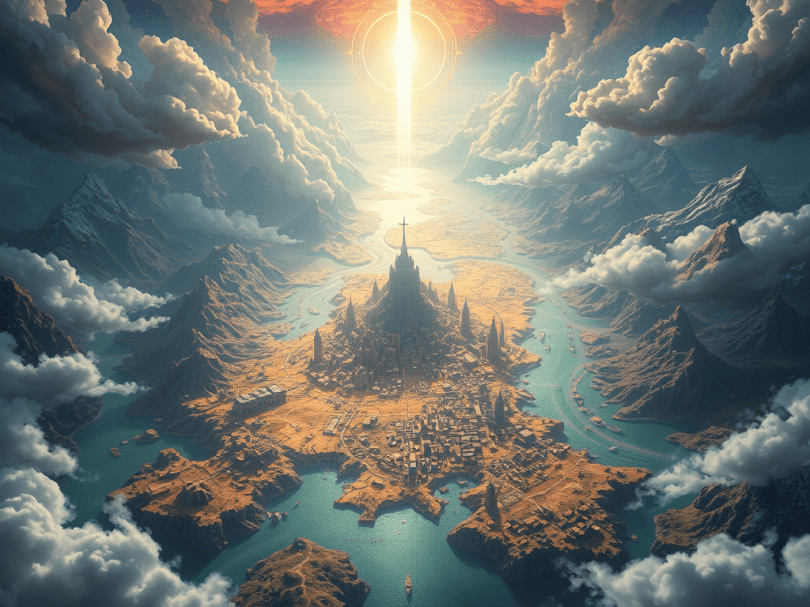
Crafting Fantasy: The Creative Journey Behind The World of Pillar

The World of Pillar is the larger moniker I have given to what I assume is going to be a trilogy of books. The first of these has been given the title The Gunslinger and the Beast, with the next in line being titled The Mamon Engine. It might seem odd at first that I know the first two books’ titles, but oddly enough, I am more sure about the second book’s title than I am the first. That is because, currently, the second of the books is nearly done, and the first is about a third of the way done. In the beginning, these first two books were just one volume. However, after hitting just over 110,000 words in the book, I decided it might be better to split the story into two and allow each of the two main narratives to breathe a bit more on their own.

The current plan is to finish this first story and publish it, followed by finishing up the second and publishing it. After those, the third story will combine characters and storylines from the first two as the main story arc concludes. Below, you will find some of the notes on the story and the world I have been playing with. Enjoy this look into the creative process I am working on.

I have envisioned that The World of Pillar is, in fact, Earth far into our future. I have long been a student of the fantasy genre, and many of the classic and modern writings have entertained me for years. When I was in my undergrad, I started reading The Wheel of Time by Robert Jordan and later finished by Brandon Sanderson. It took me years to actually finish the series, not only because it wasn’t finished being written yet, but because it was a very thick tale to move through.

I love Jordan’s fantasy world! While I could never hope to write something on his level, he inspired me greatly. One of the aspects that I really enjoyed was how Randland used to be Earth, but it was in the far future, and the world had been broken to the point that no one remembered it as it had been before. Jordan was sneaky, though, and gave hints throughout the books about the world’s previous status. A lot of the prophecies and histories also provide hints.

When I sat down to write my fantasy, this was a path I wanted my world to trod as well. However, while you really have to look closely at Jordan’s novels, I wanted mine to be fairly obvious if you took the time to really look at the world I was revealing. So, while my text doesn’t come out and say that the world is Earth and nothing overtly yells it out, you can infer the reality of this through many aspects of the story and world. One of the main aspects of this is shown in the map of the surface of Pillar. I created this map and had an artist draw it up from my creations.

Maps and Other Drawings:

The map of Pillar was created using a flood map from the YouTube channel called Worldostats and their video titled USA Flood Map | Sea Level Rise (0-4000 meters). If you watch the video and stop it when the sea level is at 280 meters, you will see the main area of Pillar pop out. I have included a screenshot of the video and placed a grey circle around where Pillar was then pushed up out of the earth, seven miles into the air, after all the flooding.

YouTube video from Worldostats, that I paused to create my first map.

I actually laid a piece of tracing paper over my laptop screen to trace the general shape of this map onto paper. Then, once I had the general shape, I bought a full-size map of the eastern coast of the United States and began coloring. In an evening or two, I had a rather large map that I could use to really look into the details of travel and areas that I could play with. It’s interesting to me that with a couple of crayons and a cheap map from Amazon, one can give life to a world that is as vast and intricate as The World of Pillar. Here is that map.
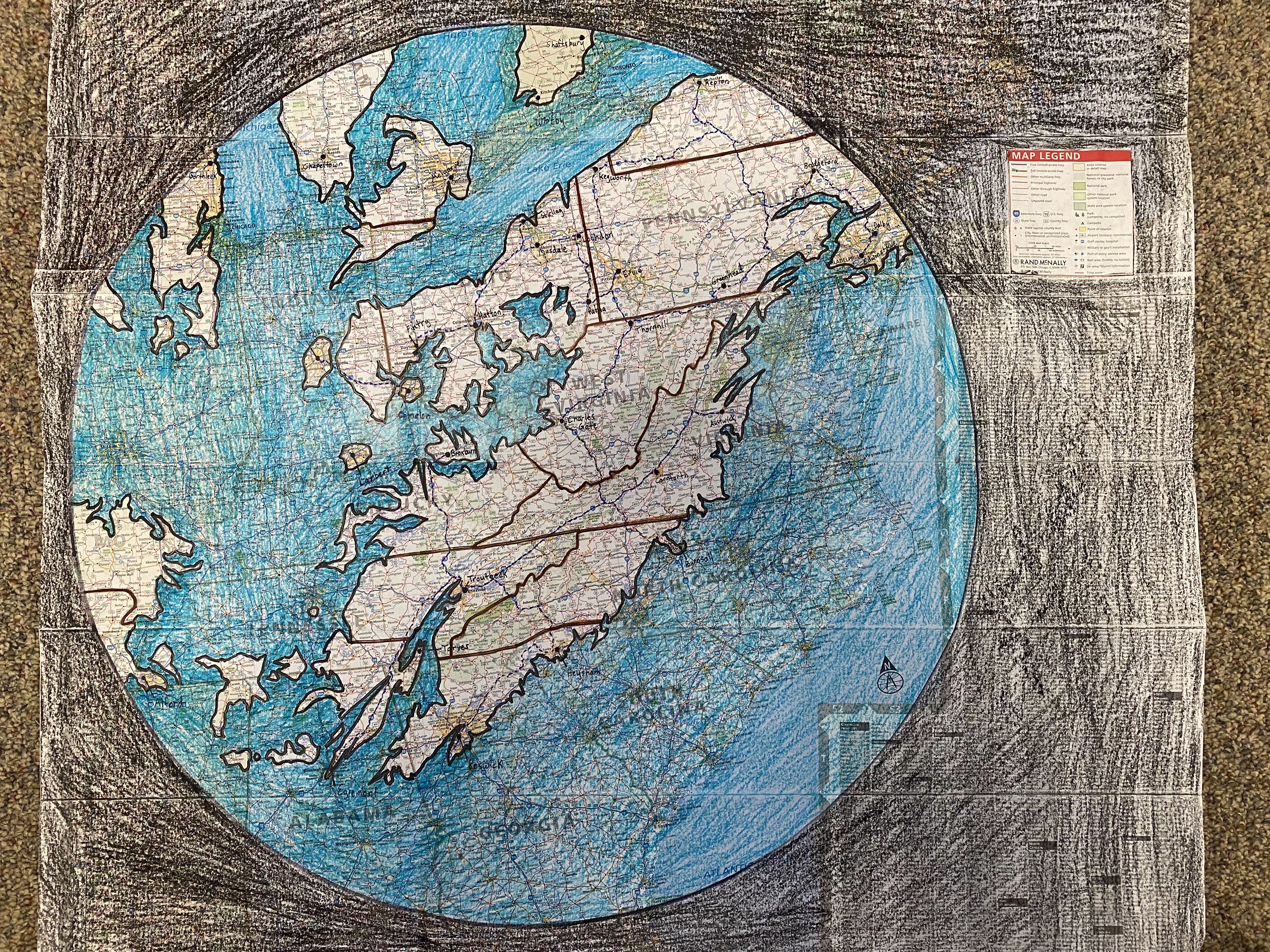
The real world map that I destroyed to create a full-size map of Pillar.

This map hangs above my table downstairs in my basement, where I have written most of the story. Other pictures are hanging in the same place. I photocopied pictures from historical texts from when I was still in college, and other things. There are character sheets and timelines, as well as other drawings of armor, weapons, and even flying ship floor plans.

The folding table in my basement is surrounded by my maps, drawings, and ideas. This is where I do a lot of the writing for my books.

Where did the story come from?

When I was back in college, I had two fantasy stories in my head. One of them was a grand fantasy that would take place on top of a huge pillar up in the sky. I was inspired by the video game Chrono Trigger and the Kingdom of Zeal in the Antiquity timeline. I loved that idea of a place separated from the rest of the world, up in the sky. The other story was a much more personal and down-to-earth fantasy that involved animals in a time far in the future when there were no more humans. This story was going to feature mainly dogs, but also other animals like deer and cats.

In the end, I took both ideas and combined them into a single world and story. The dogs, of course, remain, and the use of other animals as well, but I have chosen to place them into a more grand and far-reaching story in the future, where the creation of a giant plateau in the clouds has nearly destroyed Earth. When the ideas were still new, I first envisioned a female protagonist who was a magic user but never aged beyond twelve. I wanted to play off the idea that wizards were usually frail in physical form but powerful in magic, and using a young girl played into this idea nicely. However, the more I got into the story and started really detailing some of the plot points, the more I got uncomfortable placing a young girl in some of those situations.

I split that character into two separate characters. Thus, the characters of Christoph and Meshiah were born. At the beginning of my writings, Meshiah was a human throughout the story. Still, the more I wrote about her and Schalk (a Brown Dog), the more I really wanted their relationship to be able to blossom into something more than just a friendship. While interspecies relationships are mentioned as being a thing in the world, I didn’t want to directly tackle that sort of ethical difficulty in the main storyline. As such, allowing Meshiah to be changed into a brown dog species in the beginning created a fun narrative beat and also a direct connection to Schalk as a romantic interest in her new life.

Meshiah and Schalk. I commissioned this picture before I switched her to being a Brown Dog.

The Magic of Creativity:

Magic has captivated me for as long as I can remember. As children, we all dream of possessing powers beyond our reach. I recall a neighbor friend standing on a tree stump, arms outstretched, convinced she could feel herself lift off the ground. She’d rise onto her toes, only to “lose it” and fall back down, claiming she just needed more practice before she could truly fly.

I believe this longing for the fantastic is hardwired into us. Yet, as we grow older and reality settles in, many of us lose touch with that wonder. It’s a tragic loss, really. But there are still moments when we allow ourselves to indulge in that innate desire for magic, like when we become emotionally invested in a great movie, a compelling book, or a great video game.

Take Old Yeller, for example. (Fair warning: spoiler ahead, though the Disney film is over 65 years old, and the book is even older.) In the story, a frontier family faces hardship when the father, Jim, leaves to sell cattle, entrusting his son, Travis, with the responsibility of the household. During Jim’s absence, Travis meets an old yellow dog who proves his worth by saving his younger brother from a bear. Though Travis initially dislikes the dog, their bond grows strong, and eventually, he loves the dog.

At the story’s heart-wrenching climax, Old Yeller fights off a rabid wolf. During that time, there was no cure for rabies. When the dog shows signs of the disease, Travis’ mother hands him a rifle, knowing what has to be done. With a heavy heart, Travis shoots his beloved companion, breaking not only his own heart but the hearts of countless readers and viewers.

However, the story doesn’t end on a hopeless note—Old Yeller had fathered a pup before his tragic end. Though Travis initially resists bonding with the puppy, he eventually recognizes Old Yeller’s spirit in the pup and names him “New Yeller.” My retelling may be simple, but even now, the memory brings tears to my eyes. The emotional impact of a boy having to put down his best friend is a wound many of us still carry, who have seen the film or read the book.

Why do stories like this affect us so deeply? Why do we cry over fictional characters and events? After all, we aren’t the ones forced to kill our beloved pets. Yet, we feel it as if we are. The emotion of it is real.

That’s the magic of storytelling. When we watch a film, read a book, or play a game, we become a part of those worlds. We are Travis Coates. We are Master Chief, Frodo Baggins, Chrono, Rand Althor, or Link. For a time, we embody their struggles and triumphs, feeling every loss and every victory. It’s why we choke up when Samwise Gamgee declares he can’t carry the ring, but that he can carry Frodo, lifting him to his shoulder.

In these moments, we’re not just spectators—we are the heroes. I may never save the world from an evil sorcerer in reality, but through stories, I can be Link, fighting to protect Hyrule from Ganon’s grasp. I’m only a school counselor and author in the real world, but through the boundless creativity of humanity, I can rule kingdoms, save worlds, lose them, and live a thousand lives.

This is the true magic we all possess: the ability to connect to infinite worlds through our imaginations. It’s what makes us truly human. Magic is real—alive in every story we tell, in every fantasy we explore, and in the infinite potential we hold within ourselves.

D. Michl Lowe

How Brandon Sanderson Gives Me Hope as an Author

Brandon Sanderson, author of books like The Mistborn Saga and the Stormlight Archive Series, is a literal force within the Fantasy genre. He is a machine of creativity and pushes out books faster than his fan base can read. On top of all that, you might think that writing at a pace like that makes his books seem rushed, but they don’t. Brandon’s books are carefully crafted universes with complex characters and detailed plots. In short, he is currently one of my absolute favorite authors. So, let me talk about what I consider his worst book and why I love it so much!

I am nearing the end of Brandon’s first published novel (I think), Elantris. Published in 2005 by Tor Books, this entry into the Cosmere, Brandon’s connected universe of books, is widely regarded as Brandon’s entrance into the world stage as a successful author and his weakest entry overall. Overall, much has been said about the book, but this is not a critique of Elantris as a novel. As is often the case with authors, I constantly compare myself and my writing to those I read. 

I have written about it in the past, but authors are notorious for believing their own writing is no good, that no one else will want to read the book they write, or that they are not as good as such and such an author. I am guilty of this, as I am sure many others reading this are as well. Comparison is a natural tendency within writing circles. And as most prolific writers are also prolific readers, it makes sense that they would draw comparisons between themselves and others. 

Is this a bad thing? No, of course not. Reading other’s writings and looking at their style, character progression, and world-building is a great way to improve your craft. Reading has opened my mind to the possibilities of creative magic and the possibility of writing. I know this is an old reference, but the video game Myst was very popular back then. The creators of that videogame series, Rand and Robin Miller, along with author David Wingrove, wrote three fantasy novels about it, compiled here as The Myst Reader.

In those books, the characters write in books that bring the worlds they describe to life and allow the person to travel to the worlds they write about. What an interesting analogy to real-life authors and the worlds they create for us to read about. It allows us to travel anywhere the author’s imagination can dream up for us. A gift that continually keeps giving as more and more authors dream and write. 

So, why do I say that Brandon’s worst book gives me hope? I started reading Brandon with Mystborn and moved on to the Stormlight Archive soon after. Since then, I have read most of the books of the Cosmere and have come to absolutely love these characters and stories. That said, as I started my first journey into the world of Elantris, I found the characters, magic, and even the world to be a little flat in comparison. Not that the story wasn’t good; it was. It’s not that the characters weren’t well-developed or fun; they were. Not that the magic system wasn’t complex; it was. But, compared to Brandon’s other stories, there was no comparison. 

Whenever I read through my own stories, I find all the mistakes and sections I wish were better written. As the author, I am my worst critic. I read things like Oath Bringer, and see the complex characters, detailed plot and completely unique world, and feel like my own characters are flat. My own plot is boring and my own world just isn’t unique enough. If there arent giant crabs attacking magical knights, its just not good enough, but then I read Elantris.

I read Elantris and saw the beginnings of a fantastic author. This first story is a beginning, a stepping stone to what I feel is the greatness of one of my favorite authors. Because of that, I feel like there is hope for me. There is hope for the beginning author, the unpublished, and those still struggling. I see Prince Reoden through his ordeal and understand that my ordeal of being a new author is the same: struggling to find my own magic, my own world, and my own characters. They can be great, even in the beginning phases of creativity. It gives me hope to see Brandon Sanderson’s beginnings and know that I can be there as well. Thanks for your beginnings, Brandon. Thanks for giving us your initial struggles so that we can recognize those struggles in our own writing.

D. Michl Lowe

The Need for Honorable Men

This is the introduction to the book Men of Valor, by D. Michl Lowe.

I have sat back and waited. Waited on the church. Waited on my friends. Waited on society. Waited for them to start moving, to wake up and see that our world is dying. The earth itself seems to be groaning. There is a palpable tension in the air. Evil is no longer allowed to be called evil and even those who prey upon children are starting to no longer be vilified. Not to mention the devastation of abortion. There is a great need in our culture to begin unraveling the problems that most of society no longer calls sin. It must start with Christian men. It must start with them standing up to be counted.

Creating a new way of living. Showing the love and truth of Christ to the dying world, but also working to show that men are culturally here to stay. That masculinity is not something shameful, but a prideful way of expressing gender that sets us apart from our wonderful ladies. We are strong, resolute in our faith, and gentle in our demeanor. We are silken iron.

The sad truth of today’s culture is that it has become normal to understand that men are stupid, clumsy, fat, lazy, and just useless. We see characters like Chandler and Joey from the sitcom Friends who are bumbling idiots only really interested in sex. The women of the show manipulate them constantly using sexual innuendo to get what they want. In one episode, the boys have rightly won the right to live in an apartment from the girls, only to have the two girls kiss each other in front of the boys in payment for the apartment. The boys leave the apartment saying, “Totally worth it! Then go into their separate rooms giving the impression they are going to go masturbate with the memory of what they have seen. These types of scenarios play out constantly in this show.

Or we see the characters Homer Simpson and Peter Griffin from The Simpsons and Family Guy, who are always doing stupid things. Countless times in shows like these, men are nearly always seen as the idiots and women seen as the voice of reason. I understand that this is done for comedic purposes, but men are the butt of jokes nearly all the time. It is rare to see a woman portrayed in this manner. Sitcom comedies do this so often, that the idea of masculinity is now seen as negative or even wrong. This is sad because masculinity is needed. Yes, that is a bold statement to make, but one that needs to be made. Masculinity is seen as unintelligent and even crass and uncouth. To some degree, men have not helped this stereotype with our sometimes-stupid antics, but this does nothing to degrade the need for masculine men.

Matt Walsh a popular online blogger and conservative commentator said it well;

“Disrespect for men is a joke to us now. A little while ago I stopped on the way home from work to buy my wife some flowers. As she rang me up, the cashier quipped: ‘Uh-oh, what’d you do?’ I wasn’t particularly amused, but I chuckled. She continued. ‘I don’t know if that’ll be enough to get you off the couch tonight!’ Ah, yes, the old “husband is punished by his wife and sent to the couch” meme. I’m not sure if this actually happens in real life, or if it’s an invention of 90’s ‘all men are fat, witless, oafs’ sitcoms, but the popularity of the stereotype is telling. Is this how we see husbands now? A man gets ‘in trouble’ with his wife, she scolds him and puts him in time-out on the couch. Now he must placate his alpha-bride by showering her with flowers and jewelry. Men are painted like children or dogs. They can be shooed off their own beds by their wives and sent to cower in the living room until she permits him to return. This is only slightly less offensive than the cliché of the sadistic wife who punitively withholds sex from her husband. ‘You didn’t clean the garage like I told you. No sex for you, mister! Next time, follow my instructions!’”

In our schools, typical male childish behavior is seen as deviant and a problem. Psychologist Michael Thompson has famously said that girl behavior is the gold standard in schools and boys are treated like defective girls. It is sad that boy behavior is so misunderstood and hated. Our young boys are treated with disdain and are misunderstood, recently in the news, I saw where a young boy in grade school bit a pop tart into a gun shape and started playing with it. He was promptly expelled from school. This type of intolerance isn’t right.  Our teachers are hamstrung in being able to implement discipline for actual negative behaviors and mandated paperwork for oversight has made it difficult to even teach what needs to be taught, so time afforded for simple physical play (an important need for young boys to exert energy) has become a secondary thought even though it’s also a mandated requirement.

This is not to say that women are less than men in any respect, but the idea that the sexes are both the same is not just silly, it’s dangerous. We are different right down to our chromosomes. Men have one X chromosome and one Y chromosome while women have two X chromosomes. Chromosomes are basically the fundamental building blocks of humanity. They contain DNA, which is the pattern by which humans are created and built. Within every human DNA is what makes a person an individual. The combining of their mother and father’s DNA has created each person; those patterns are used to create a completely new human being. Men and women are not the same and to pretend otherwise is honestly just silly.

I feel as though men are lost in our culture today. There isn’t a place for men to truly be men and embrace our masculinity. They search for meaning and purpose. One of the biggest forms of entertainment in the modern age is video games. It is estimated that by 2019 videogame yearly sales revenue would be around 41 billion dollars, not a small industry to be sure. It is a well-known fact that men tend to be consumers of the higher-end video game industry. While many women have broken into casual gaming, which accounts for many of the skewed statistics stating that women make up more than 50% of gamers, they continue to be underrepresented in the mainstream gaming market.

We would refer to most male gamers as “core” gamers in this respect, not players of Candy Crush or Angry Birds, as fun as those are. Some of this trend is changing with games that are marketed directly to women, but now it’s just the way things are. Why do so many men flock to video games? Besides the sports genre (which I believe is popular for different reasons), many of the games we see men playing involve stories and situations in which the player may assume the “role” of a hero of some kind.

Within the role of the male hero is the question, “What does it mean to be masculine?”. This idea of masculinity is idealized in the role of the male hero. Most men have a desire to be the hero of their own existence. In many PC games, one takes on the role of a hero that starts off as mostly a normal person, but through adventures and fulfilling quests begins to gain great power and becomes a leader in the vast world in which the game takes place.

In first-person shooter games on consoles and PCs alike, players often take on the role of a super soldier in a world of the future where aliens are trying to basically end all life in the universe. Through these super-soldiers, players can become the hero of the entire universe, saving humanity. It is often as if the player can save their game, sealing themselves away for a time when humanity might even need them again in the future. Self-sacrifice is a very pure form that often rises in these storylines.

While not a videogame, pen and paper role-playing games like the classic Dungeons and Dragons present a very solid argument that men are gravitating towards the realm of role-playing for a reason. In these games, you choose a “role” to play and through a form of guided storytelling, you can become the hero of your own story. Now there are a lot of reasons why all genders play these games, but for men, it often has to do with this innate desire to gain significance. God gave men this desire for significance and heroic inspiration. In Psalms 57:2 David says, “I cry out to God Most High, to God who fulfills His purpose in me.” God calls all his people into glorious purpose. For men, this is often a desire to achieve significance and meaning. This isn’t a bad thing. In the realm of working towards achieving Christ’s purpose and meaning for our lives, men can find a true significance, but when we look past God to the world for significance, something is lost.

A while back, I sat in a very questionable chair in the back of a dirty and rundown shop in a very bad part of town. My wife was worried that I was going to this place; a day before, someone had been shot only one block from this store. There were about eight of us and the unkempt appearance of the other men around me might have off-put many (along with the smell), but I was comfortable in this place. Dungeons and Dragons had a way of bringing people together. However, on this day, the man on my left was not very happy. He had failed in several rolls of the dice and his character was on the verge of death. He angrily shouted at the Dungeon Master (the leader of the game) that it wasn’t fair, letting multiple expletives leave his person.

After the game was over, he was packing up all his books and little plastic figurines he angrily threw his pack on and stormed from the table, leaving the shop. His manhood, his meaning for life was so wrapped up in the fictional character he had created, that losing it was like losing part of who he was. It was sad to see. Shouldn’t there be more for men in this life? Shouldn’t there be more for them to strive for than just a fictional monument of meaning?

The men of this generation are lost, children. Society has taken away the villains and often even denies that such a thing exists. It is no longer good or evil, there are only differing opinions and cultures. No one is wrong, and everyone is right. There isn’t an outlet for masculinity in American society that is not in some way shunned. Men are now the aborted children of society and it is time for them to take a stand and become something more than just a joke. It’s time for true purpose to come back into the darkened hearts of men.

The truth of the issue is, there is evil in the world. Some issues are not questions, but facts. There is a great need for men to be willing to stand up and be accountable to the society they live in. It is time for us to step onto the dais of history once again and take a stand for what is right. There are certain truths in this world that should be observed and should be written in stone. There are ways of viewing the world that is right. The way men treat their fellow human beings matters. One of the greatest tragedies in this life is that evil prevails because Christian men choose to do nothing. The children of God have set on the sidelines for too long and allowed the truth to be kidnaped.

The truth has a nasty way of being unpopular. No one wants to hear the truth; people want you to agree with them and validate that what they have already decided is okay in their minds. There are no real attempts to understand the other side; there is only the manipulation and deceit of tolerance. It is this idea of tolerance that’s only there to convince you that this other person is on a higher moral level. Do not be deceived into the idea that tolerance and understanding are right because “everyone is okay”; that every idea is right and moral. Acceptance is only possible if you don’t disagree and don’t speak out. According to society, the status quo of tolerance and acceptance must be maintained above all other ideals. Understand the spiritual and intellectual warfare that is going on and continue to speak the truth regardless. This is a verbal war that will not stay in that realm for long, violence and death are already in the streets.  

The stance of moral and Christian truth will only be allowed for so long. Freedom as an idea is slowly moving towards being parallel with the status quo. This isn’t a call to rebellion in the sense of militaristic action, but it is a call to a rebellion of conscience and behavior. Within a framework of honor and Christian faith, men can begin to unravel the current culture of compliance and tolerance. Standing for Christian truth is not hard, but it will cost you. In fact, at some point in the future, it could cost you everything. Still, what is your soul worth?

“For what does it profit a man to gain the whole world, and forfeit his soul?” Mark 8:36.

Men are becoming what society has wanted them to become, pitiful creatures that are ashamed of their own masculinity. The men make a case to dismiss God so that they can ignore his law and live their lives in selfish admission. Distractions and sin have led to a willingness to live a blinded life; a life ignorant to their own destruction. Hedonism is the new vogue and it is the greatest lie that men believe to be true. Brief moments of pleasure and fun are constantly sought out and chased after. Downtime is filled with small screens, meaningless memes, and videos of cats with bread on their heads. What are men doing with their lives? What purpose is there? What meaningful significance is there to this existence if we pass into history without changing anything for God’s better plan?

As Paul Bois said in his Oct. 17th, 2017 Daily Wire article,

“…when knights surrender their swords, beasts shall devour maidens.” In a country and culture ruled over by Harvey Weinsteins, one can only raise the question; as Paul asks, “Are there any knights left”?

This has been the Introduction to Men of Valor, by D. Michl Lowe. Available now in full from this website. or at the link here:

https://amzn.to/3PiWUoz

D. Michl Lowe